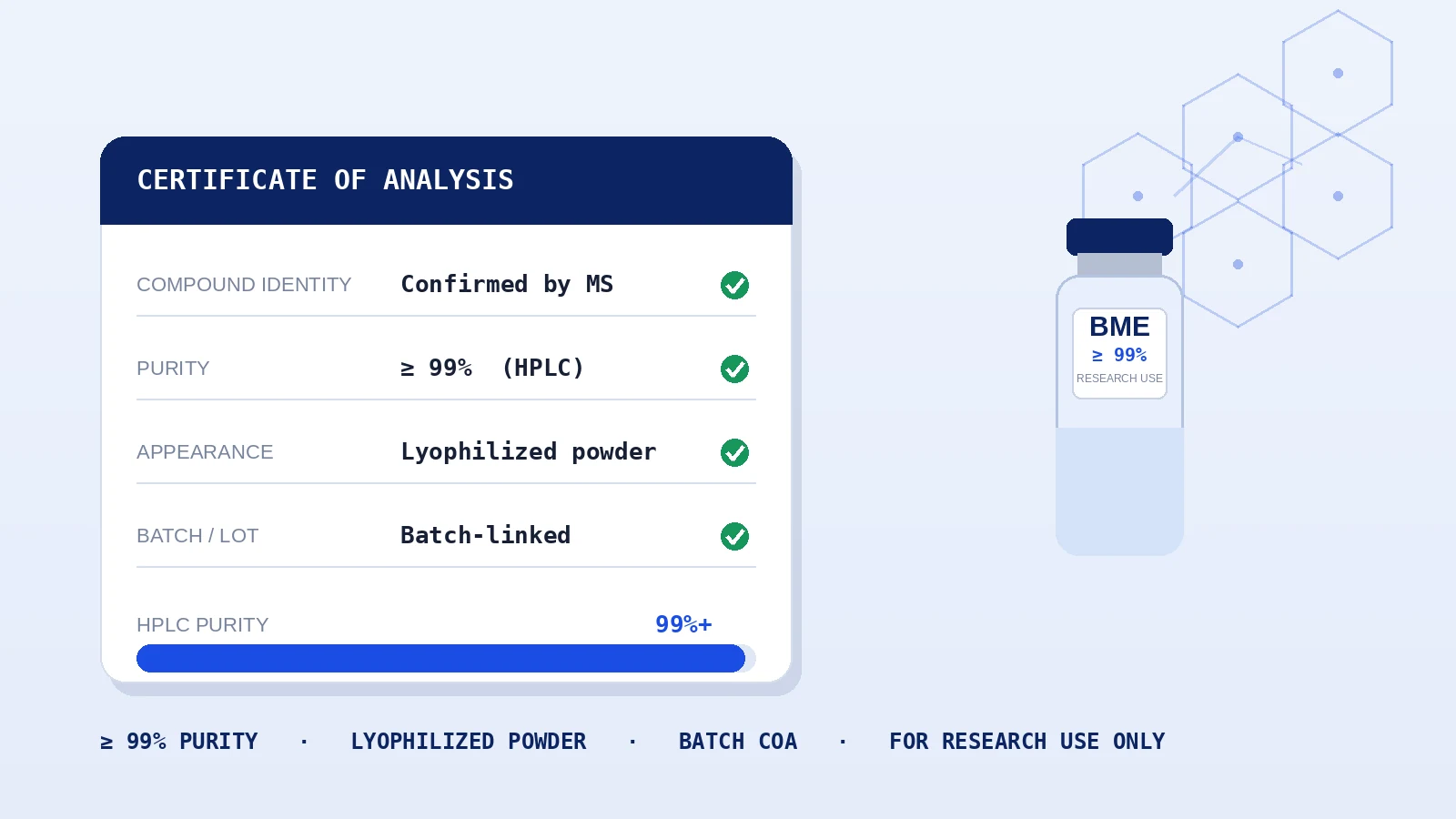
If you source research peptides, you have probably seen the phrase "COA available" on a product page. A Certificate of Analysis is the single most useful document for understanding what is actually in a research vial — but only if you know how to read it.
The fields can look cryptic at first: a purity percentage, a chromatogram, a molecular weight, a batch number, a testing-method acronym or two. This guide walks through what each part of a peptide COA means, how the common testing methods work, and — just as importantly — what a COA can and cannot tell you. Everything below is written for research and laboratory context. BME Health supplies research compounds for laboratory use only, and this article is about documentation literacy, not about how any compound is used.
What a Certificate of Analysis Actually Is
A Certificate of Analysis is a document that reports the results of laboratory testing performed on a specific batch of material. The key word is specific. A COA is tied to one lot or batch, not to a product line in general. If a supplier tests a new batch of a compound, that batch gets its own COA with its own results, rather than reusing numbers from a previous lot.
At minimum, a peptide COA is trying to answer two questions: is this the molecule it claims to be (identity), and how much of the sample is that molecule versus everything else (purity)? Most of the fields you will encounter exist to support one of those two answers, or to record the housekeeping details — batch number, test date, method — that make the results traceable.
The Core Fields on a Peptide COA
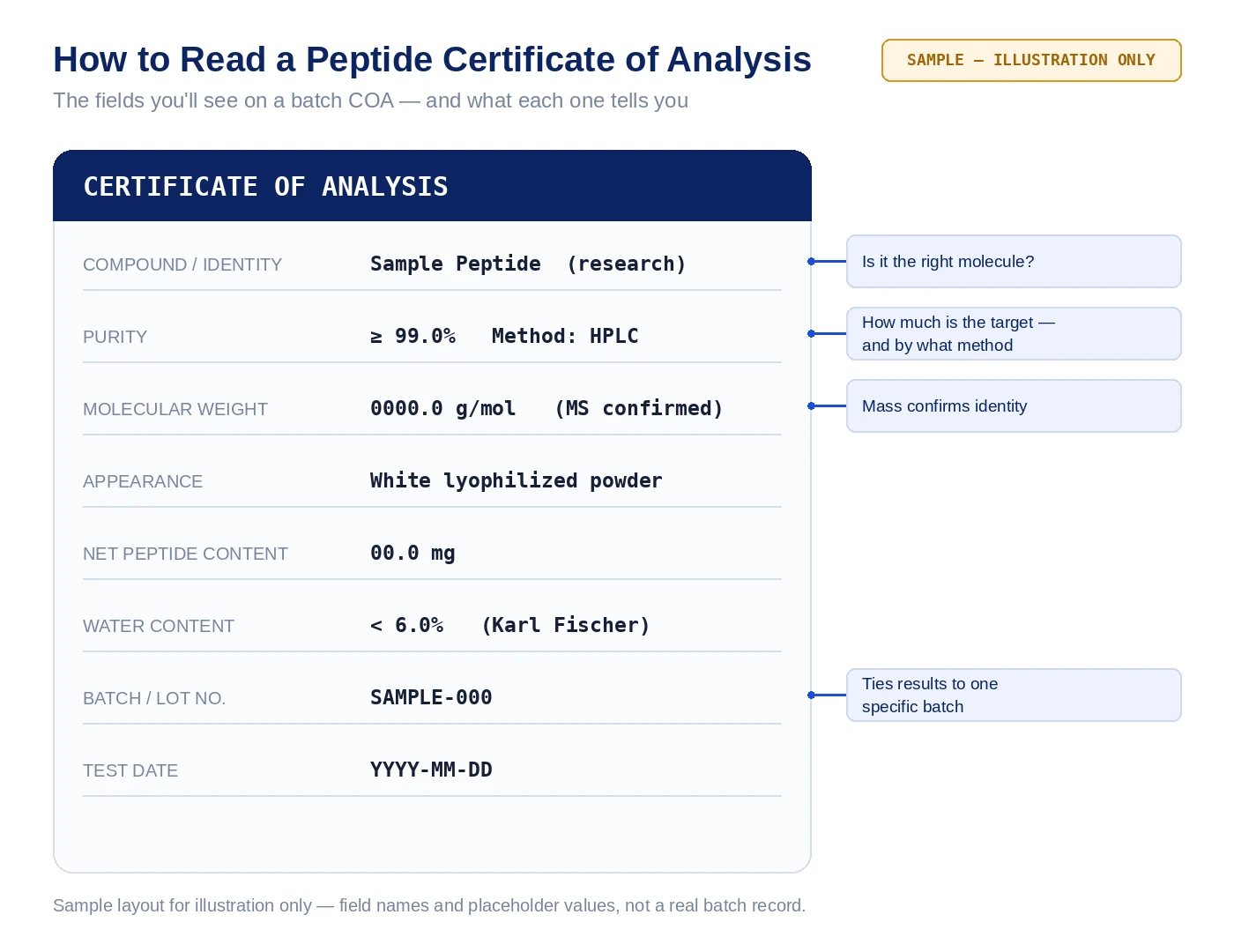
COAs are not perfectly standardized between labs, so the exact layout varies. The following fields are the ones you are most likely to see, and the ones worth understanding.
Product name and identity
The top of the COA states the compound name and often a sequence or CAS-style identifier. This is the "what is it" line. On its own, a name is just a label — the identity is only meaningfully confirmed further down by an analytical method such as mass spectrometry. When reading a COA, check that the stated name and any molecular formula or sequence match the product you are evaluating.
Purity (%) and how it is measured
Purity is usually the headline number, commonly reported as a percentage such as "≥99%." In peptide work this figure almost always comes from HPLC (high-performance liquid chromatography), and it represents the proportion of the total signal attributable to the target peptide. An HPLC run separates the components of a sample over time; each component shows up as a peak, and purity is calculated from the target peak's area as a fraction of the total peak area. A purity of 99% by HPLC means the target peptide accounts for about 99% of the detected material, with the remaining ~1% being related peptides, synthesis by-products, or other detectable impurities.
Two nuances are worth holding onto. First, purity is method-dependent: a percentage only means something in the context of the method that produced it, which is why a good COA names the method. Second, purity describes composition — how much of the sample is the target molecule — and nothing more. It is not a statement about safety, suitability, or performance of any kind.
Molecular weight and mass spectrometry
Identity is typically confirmed with mass spectrometry (MS), which measures the mass of the molecule. The COA may list a theoretical (calculated) molecular weight alongside an observed (measured) mass. When the observed mass matches the theoretical mass within the tolerance the testing laboratory specifies — tolerances are set by the testing laboratory rather than by any single universal standard — that supports the conclusion that the material is the intended peptide rather than a different sequence of similar size. Reading this field is a matter of checking that "found" lines up with "expected."
Appearance, net peptide content, and water or residual solvents
Several supporting fields round out the picture. Appearance describes the physical form, often a white or off-white lyophilized (freeze-dried) powder — a basic visual identity and consistency check. Net peptide content can differ from gross mass: a vial's contents include counter-ions, bound water, and residual salts from synthesis, so the actual peptide mass may be somewhat lower than the total powder mass. Water content (often by Karl Fischer titration) and residual solvents report leftover moisture or manufacturing solvents; lower, within-spec values are what a COA is demonstrating.
Batch/lot number and date
Finally, the batch or lot number and the test date make the document traceable. Because a COA is batch-specific, this is what lets you match the certificate to the exact material in front of you. If a product page links a COA, the batch on the certificate should correspond to the active batch being listed.
Identity vs Purity — Why You Need Both
It is tempting to treat the purity percentage as the whole story, but identity and purity answer different questions. A sample could be highly pure and still be the wrong molecule — very pure, but not what the label claims. Conversely, the identity could be correct while purity is low, meaning the right molecule is present but accompanied by a significant fraction of impurities. A trustworthy COA addresses both: mass spectrometry (or equivalent) for identity, HPLC for purity. When you read a COA, look for evidence of each, not just the single number.
Common Testing Methods, Briefly
You do not need to be an analytical chemist to read a COA, but a working sense of the two main methods helps. HPLC (high-performance liquid chromatography) separates a mixture into its components and is the standard basis for the purity percentage; the output is a chromatogram — a plot of detector signal over time — where each peak is a component. Mass spectrometry (MS) measures molecular mass and is used to confirm identity: it answers "is this the right molecule?" by comparing measured mass to the expected value. Some COAs include the chromatogram or spectrum image itself; others summarize the numeric results. Either is acceptable as long as the method is named and the results are legible.
What a COA Does Not Tell You
A COA is powerful precisely because it is narrow. Understanding its limits is part of reading it well. It is batch-specific — results apply to the tested lot, not to every lot ever produced. It reflects the sample tested — a certificate documents what a lab measured on a representative sample under a stated method; it is not a live readout of the vial in your hand. It is a composition and identity record, not a fitness-for-purpose statement — a COA does not establish that a compound is safe, effective, or suitable for any application; those are separate questions that a purity figure cannot answer. And methods and tolerances matter — a percentage without a named method, or an identity claim without a supporting measurement, is weaker than one with full detail.
Keeping these limits in mind prevents the most common misread: treating "≥99% pure" as a seal of overall quality or suitability, when it is strictly a statement about how much of the sample is the target molecule. For context on how individual compounds are discussed in the research literature, see our compound overviews such as BPC-157.
How BME Health Documents Every Batch
BME Health's approach maps directly onto the fields above. Each batch is purity-tested before it is listed, and results are recorded and linked to that specific batch rather than carried forward from a prior lot. Those results are compiled into a Certificate of Analysis that includes compound identity, purity percentage, and testing method, and the COA is linked at the product-page level — accessible before and after purchase. Purity and identity are verified using standard analytical methods appropriate to each compound, including HPLC where applicable, and storage conditions are noted per product. In other words, the documentation you have just learned to read is exactly what a BME Health product page is designed to show. You can see the full process on the Quality & Testing page.
Frequently Asked Questions
What does "≥99% purity" on a peptide COA mean?
It means that, by the stated testing method (usually HPLC), the target peptide accounts for at least 99% of the detected material in the tested batch. It describes composition only — not safety, suitability, or any outcome.
Is a COA the same as a lab report or a chromatogram?
A COA is a summary certificate of the results. It may include or reference the underlying data (such as an HPLC chromatogram or a mass spectrum), but the certificate itself is the consolidated, batch-linked summary.
Why does the COA batch number matter?
Because a COA is tied to one specific batch. Matching the batch number on the certificate to the batch you are evaluating is what makes the document meaningful for that material.
Which testing methods should I expect to see?
For peptides, HPLC for purity and mass spectrometry for identity are the most common, sometimes with additional fields such as water content or net peptide content. The COA should name the methods it used.
The Takeaway
A Certificate of Analysis is the clearest window into what a research vial actually contains — provided you read it as what it is: a batch-specific record of identity and purity produced by named methods, with real but bounded scope. Check that identity is confirmed, that purity is reported with its method, and that the batch number matches the material.
Sources
- Sigma-Aldrich (Merck). Peptide Sample Amount Determination. Purity determined by HPLC with detection at 214 nm where the peptide bond absorbs; purity does not account for water and salts present in the sample. View source
- National Cancer Institute, Nanotechnology Characterization Laboratory. Determination of Water Content using the Karl Fischer Coulometric Method. NCBI Bookshelf. View source
- BME Health. Quality & Testing — per-batch testing and batch-linked Certificates of Analysis. View page
All external sources verified to resolve on 28 July 2026. Mass-spectrometry tolerances are set by the testing laboratory rather than by a single universal standard.
BME Health supplies research compounds for laboratory use only. This article is educational and does not describe or recommend any use of any compound. See the Research Use Disclaimer.