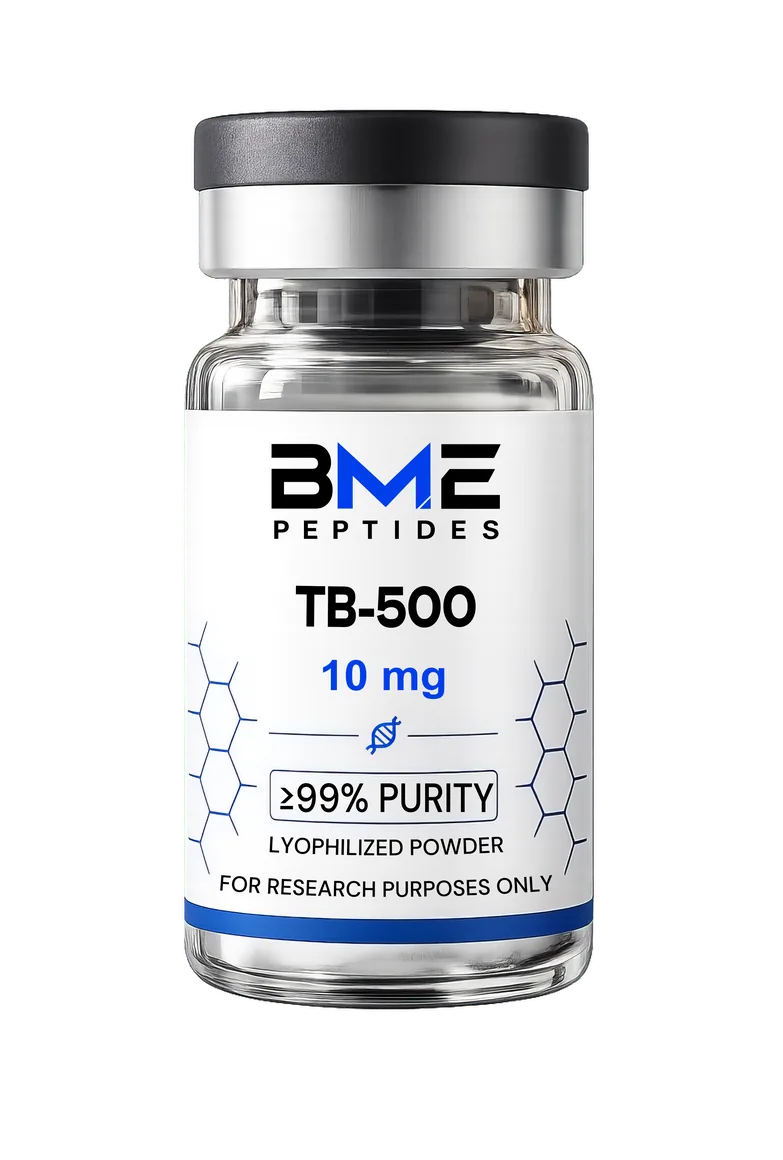
TB-500 is the research and vendor name for thymosin beta-4 (Tβ4), a peptide the human body already makes and uses as part of normal tissue biology. It is encoded by the TMSB4X gene, found in virtually every cell type, and plays a role in how cells move, how wounds close, and how tissues rebuild after injury. The fact that thymosin beta-4 is endogenous gives it an inherently compelling starting point as a research subject: scientists are not studying a foreign molecule, but asking how a natural process might be amplified or supported.
Research interest in thymosin beta-4 has grown steadily since the 1990s, spanning wound healing, angiogenesis, cardiac repair, skeletal muscle regeneration, corneal repair, and inflammation resolution. The breadth of that literature reflects the compound's fundamental role in cell biology: actin dynamics, the process thymosin beta-4 directly regulates, are central to how virtually every cell moves and responds to injury, making the research implications wide.
TB-500 is available from BME Health as a research compound for laboratory use only.
1. What Is TB-500?
TB-500 and thymosin beta-4 refer to the same underlying molecule. Thymosin beta-4 is a 43-amino-acid peptide, small by protein standards, originally identified in thymus tissue and later found to be expressed throughout the body. Researchers studying its biology eventually narrowed much of its functional activity to a short four-amino-acid sequence (LKKTETQ) contained within its structure. This sequence is central to its actin-binding and cell-migration effects.
The compound is encoded by the TMSB4X gene, catalogued at NCBI, placing it firmly in the landscape of well-characterized human biology. Unlike fully synthetic peptides built from scratch, thymosin beta-4 is derived from a known, endogenous source, a distinction researchers have found meaningful when evaluating its biological plausibility.
"TB-500" specifically refers to the synthesized form used in laboratory research, as opposed to naturally produced thymosin beta-4 in the body. There is no approved drug equivalent in any
major jurisdiction.
2. Why TB-500 Gets So Much Attention
The central reason thymosin beta-4 attracts so much research attention comes down to what it does at the cellular level: it regulates actin.
Actin is the structural protein cells use to change shape, move, and migrate. When tissue is injured, cells at the wound edge must migrate into the damaged area to begin rebuilding. That process depends on the controlled assembly and disassembly of actin filaments within the cell. Thymosin beta-4 directly participates in this: it binds G-actin (the monomeric, unpolymerized form) and controls the pool of actin available for polymerization, effectively influencing how readily cells can extend, migrate, and reorganize.
That makes it relevant not just to surface wound healing, but to any repair process that requires cell migration, including tendon repair, vascular remodeling, cardiac regeneration, and corneal healing. The mechanistic relevance across tissue types is a key reason the literature on TB-500 spans so many research contexts.
Researchers also note that thymosin beta-4 levels are measurably upregulated in healing tissue following injury, suggesting the body already uses it as part of its endogenous repair response. Studying whether exogenous TB-500 can extend or amplify that response is a natural extension of that observation.
Those researching BPC-157 alongside TB-500 will find both compounds in the tissue-repair literature, but arriving from very different angles. BPC-157 acts primarily through vascular and cytoprotective pathways; thymosin beta-4 acts at the cytoskeletal level, influencing the cell migration machinery itself. Researchers have explored these two compounds together in the BPC-157 and TB-500 combination research context, with the mechanistic complementarity being part of the interest.
3. Wound Healing and Tissue Repair
Wound healing is one of the most extensively documented areas in the TB-500 / thymosin beta-4 literature. Studies across dermal, corneal, and mucosal wound models have found that thymosin beta-4 treatment is associated with faster wound closure, improved cellular migration into the wound bed, and more organized collagen deposition in healing tissue.
In dermal models, researchers have found thymosin beta-4 accelerating re-epithelialization and reducing wound-closure times compared to untreated controls. The mechanism ties directly to actin dynamics: with more G-actin available for polymerization, keratinocytes and fibroblasts at the wound edge can migrate more efficiently into the wound.
4. Angiogenesis and Vascular Remodeling
A second major research area is angiogenesis, the growth of new blood vessels into healing or ischemic tissue. Thymosin beta-4 has been studied in a range of vascular models and found to promote endothelial cell migration and the formation of tubular structures that precede mature vessel growth. This has made it a subject of interest in both wound-healing and cardiac repair research, where vascular ingrowth is rate-limiting for tissue recovery.
Searches of PubMed for thymosin beta-4 return a substantial body of work on angiogenic effects, including studies using cell culture models and in vivo animal experiments examining its effects on endothelial sprouting and VEGF-related signaling pathways.
5. Cardiac Repair Research
One of the more striking research threads in the thymosin beta-4 literature involves cardiac tissue and whether it can support repair after myocardial injury. Preclinical studies have examined its effects in ischemia-reperfusion models, where cardiac tissue is damaged by restricted then restored blood flow. In these models, thymosin beta-4 treatment has been associated with reduced infarct size, improved cardiac function, and increased cardiomyocyte survival, with researchers proposing both anti-apoptotic effects and promotion of vascular ingrowth as contributing mechanisms.
As of 1 August 2026, ClinicalTrials.gov lists 18 registered study records matching thymosin beta-4, of which 7 have posted results. The largest cluster is ophthalmic rather than cardiac: ReGenTree's RGN-259 programme has reached Phase 3 for dry eye disease (NCT03937882, NCT02974907). Cardiac work forms a smaller and more recent group, including a Phase 2 study in acute myocardial infarction (NCT05485818).
An important distinction: most of those records study full-length thymosin beta-4, not TB-500. TB-500 is a synthetic fragment corresponding to residues 17–23 of the parent peptide — a different molecule. Only one registered study names TB-500 specifically (NCT07487363, Phase 1/2, began February 2026). Clinical evidence for thymosin beta-4 therefore does not transfer directly to TB-500, and this article does not present it as if it does.
6. Skeletal Muscle, Tendon, and Ligament Research
Muscle and tendon repair are active areas as well. In skeletal muscle injury models, thymosin beta-4 has been associated with improved regeneration and reduced fibrosis, with researchers finding more organized muscle fiber architecture and better functional recovery in treated animals. Satellite cell activation (the muscle stem cells responsible for regeneration) has been proposed as one mechanism.
For tendons and ligaments, the poor vascular supply that makes these tissues slow to heal makes angiogenic peptides particularly relevant candidates for study. TB-500's dual role — influencing both cell migration and vascular remodeling — has made it a natural subject for musculoskeletal repair research.
7. Corneal and Ocular Repair
Corneal wound healing has been a productive research niche for thymosin beta-4. The corneal epithelium is rapidly regenerating tissue that depends heavily on cell migration, making it a biologically ideal model for studying actin-dependent repair. Multiple studies have found thymosin beta-4 accelerating corneal re-epithelialization following injury, and some early-phase human trials on corneal repair have been registered, as visible in ClinicalTrials.gov records.
8. Inflammation Resolution
Beyond structural repair, thymosin beta-4 research has also examined its role in inflammation. Studies have found it associated with downregulation of pro-inflammatory cytokines and NF-κB signaling in several injury models, suggesting it may help modulate the inflammatory environment in damaged tissue while simultaneously promoting structural repair. Researchers find this dual anti-inflammatory and pro-repair activity mechanistically interesting.
9. How It Works
Thymosin beta-4's primary mechanism is actin sequestration. It binds G-actin (the monomeric, free form of actin) and, by doing so, regulates the ratio of polymerized filamentous actin (F-actin) to unpolymerized actin in the cell. This regulation is not simply inhibitory: it creates a dynamic reservoir of actin monomers that cells can draw on when they need to rapidly reorganize their cytoskeleton for migration or shape change.
At the wound edge, this matters directly. Cells that need to migrate into damaged tissue must rapidly extend actin-rich protrusions called lamellipodia and filopodia. Thymosin beta-4's influence on the available G-actin pool helps enable and sustain that process. This is why its effects in wound healing and cell-migration experiments are mechanistically straightforward — it is influencing the very machinery cells use to move.
Beyond actin, the research literature identifies additional downstream effects. Thymosin beta-4 appears to interact with inflammation-resolution pathways, particularly those involving ILK (integrin-linked kinase) and downstream NF-κB activity, which may explain the anti-inflammatory observations in injury models. The LKKTETQ sequence is specifically implicated in much of this activity, and synthetic versions of just this short sequence retain significant biological activity in cell culture experiments.
10. What Researchers Are Still Learning
The thymosin beta-4 research literature is well-developed by preclinical standards, but the gap to human clinical evidence is significant in most applications. Outside of corneal and some early cardiac work, registered human trials remain limited. Most of the evidence base is from cell culture and rodent or larger animal models, and translation to human outcomes remains to be demonstrated in most research areas.
The optimal conditions for any potential therapeutic application, including concentration, timing relative to injury, and target tissue specificity, are still being worked out at the preclinical level. These are standard questions in therapeutic development research, and TB-500's investigational status means they remain genuinely open.
There is also active work on defining exactly how the LKKTETQ active sequence relates to the full-length thymosin beta-4 molecule, and whether short peptide fragments might replicate the biological activity of the complete compound. That line of mechanistic research is ongoing.
For those interested in how TB-500 research compares or relates to other peptides in the repair field, the multi-peptide research blends article provides broader context, and the GHK-Cu overview covers a third compound studied through yet another distinct mechanism (extracellular matrix remodeling and copper-mediated signaling).
11. Research Status and Sourcing
Thymosin beta-4 / TB-500 is not approved as a drug by the FDA, Health Canada, or the EMA. The FDA's bulk drug substances list for compounding includes thymosin beta-4 as a substance under evaluation, and Health Canada specifically names TB-500 as one of the injectable peptides sold under "For Research Use Only" labeling, emphasizing that such labeling does not make the product legal or exempt from Canadian drug regulations. It is also flagged in anti-doping contexts.
TB-500 is available from BME Health in 5 mg and 10 mg formats, supplied as a research compound for laboratory use only.
This article is for educational and research purposes only and is not medical advice.
12. Frequently Asked Questions
What is TB-500 (thymosin beta-4)? TB-500 is the vendor and research name for thymosin beta-4 (Tβ4), a naturally occurring 43-amino-acid peptide encoded by the TMSB4X gene. It is found throughout the body and plays a role in cell migration, actin dynamics, and tissue repair signaling. TB-500 refers specifically to the synthesized form used in laboratory research settings.
What is the difference between TB-500 and thymosin beta-4? They refer to the same molecule. Thymosin beta-4 is the scientific name for the naturally occurring peptide. TB-500 is the name used in research and commercial supply contexts for the synthesized form. The underlying sequence is identical.
How does TB-500 work in the body? Thymosin beta-4 works primarily by binding G-actin (the free, unpolymerized form of actin) and regulating the actin dynamics cells use for migration and structural reorganization. This makes it directly relevant to wound closure and tissue repair, where cell migration is essential. It also appears to influence angiogenic signaling and anti-inflammatory pathways, making its mechanism broader than actin alone.
What has thymosin beta-4 been studied for? The research literature covers wound healing, angiogenesis and vascular remodeling, cardiac repair after ischemic injury, skeletal muscle and tendon regeneration, corneal and ocular repair, and inflammation resolution. The breadth reflects thymosin beta-4's role in fundamental cellular processes common to multiple tissue types.
Is TB-500 FDA approved? No. TB-500 / thymosin beta-4 is not an FDA-approved drug. It appears on the FDA's list of bulk
substances under evaluation for compounding, but it does not hold approved drug status. It is similarly unapproved by Health Canada and the EMA.
Is TB-500 legal in Canada or the U.S.? Health Canada identifies TB-500 as an injectable peptide sold illegally under "For Research Use Only" labeling, noting clearly that such labeling does not exempt the product from drug regulations. In the U.S., it lacks approved drug status and is not authorized for human clinical use.
TB-500 vs BPC-157: what's the difference? Both are researched in tissue-repair contexts, but through distinct mechanisms. TB-500 / thymosin beta-4 acts primarily at the cytoskeletal level — influencing actin dynamics and cell migration. BPC-157 acts principally through vascular and cytoprotective pathways, particularly the nitric oxide system and angiogenic signaling. Researchers have studied both compounds individually and together, given the mechanistic complementarity. The BPC-157 and TB-500 combination overview covers this in detail.
What are the risks or side effects of TB-500? Because TB-500 / thymosin beta-4 lacks approved drug status and has not completed human clinical trials across most applications, a complete human safety and side-effect profile has not been established through standard drug development processes. No medical guidance on risks, dosing, or administration can be offered here. This is a research compound only.
13. References
- NCBI Gene. TMSB4X thymosin beta 4 X-linked [Homo sapiens]. National Center for Biotechnology Information. https://www.ncbi.nlm.nih.gov/gene/7114
- Health Canada. Using bodybuilding products safely. Government of Canada. https://www.canada.ca/en/health-canada/topics/buying-using-drug-health-products-safely/safe-use-bodybuilding-products.html
- U.S. Food and Drug Administration. Bulk Drug Substances Used in Compounding Under Section 503A of the FD&C Act. https://www.fda.gov/drugs/human-drug-compounding/bulk-drug-substances-used-compounding-under-section-503a-fdc-act
- PubMed search: thymosin beta-4. National Library of Medicine. https://pubmed.ncbi.nlm.nih.gov/?term=thymosin+beta-4
- ClinicalTrials.gov. Search results for thymosin beta-4. U.S. National Library of Medicine. http s://clinicaltrials.gov/search?term=thymosin%20beta-4 Shop this compound Documented, batch-tested, and supplied for research use only . View TB-500 10mg Keep reading Healing & Recovery GHK-Cu: What Is This Copper Peptide and Why Are Researchers So Interested in It? Healing & Recovery BPC-157: A Research Overview of the Body Protection Compound Research Glutathione: What Research Says About the Body's Master Antioxidant https://clinicaltrials.gov/search?term=thymosin%20beta-4
Shop this compound
Documented, batch-tested, and supplied for research use only.