A research-peptide specification usually condenses a fair amount of laboratory work into a few characters — "≥99% by HPLC, identity confirmed by MS." Behind those characters is a standard set of analytical tests, each answering a different, specific question about a batch.
This guide explains how research peptides are tested: what each method measures, what it cannot measure, and how the individual results are compiled into the per-batch Certificate of Analysis (COA) you see referenced on a product page. Everything below describes laboratory analysis. BME Health supplies research compounds for laboratory use only, and this article is about how testing works — not about using any compound.
The Short Answer: A Standard Testing Battery
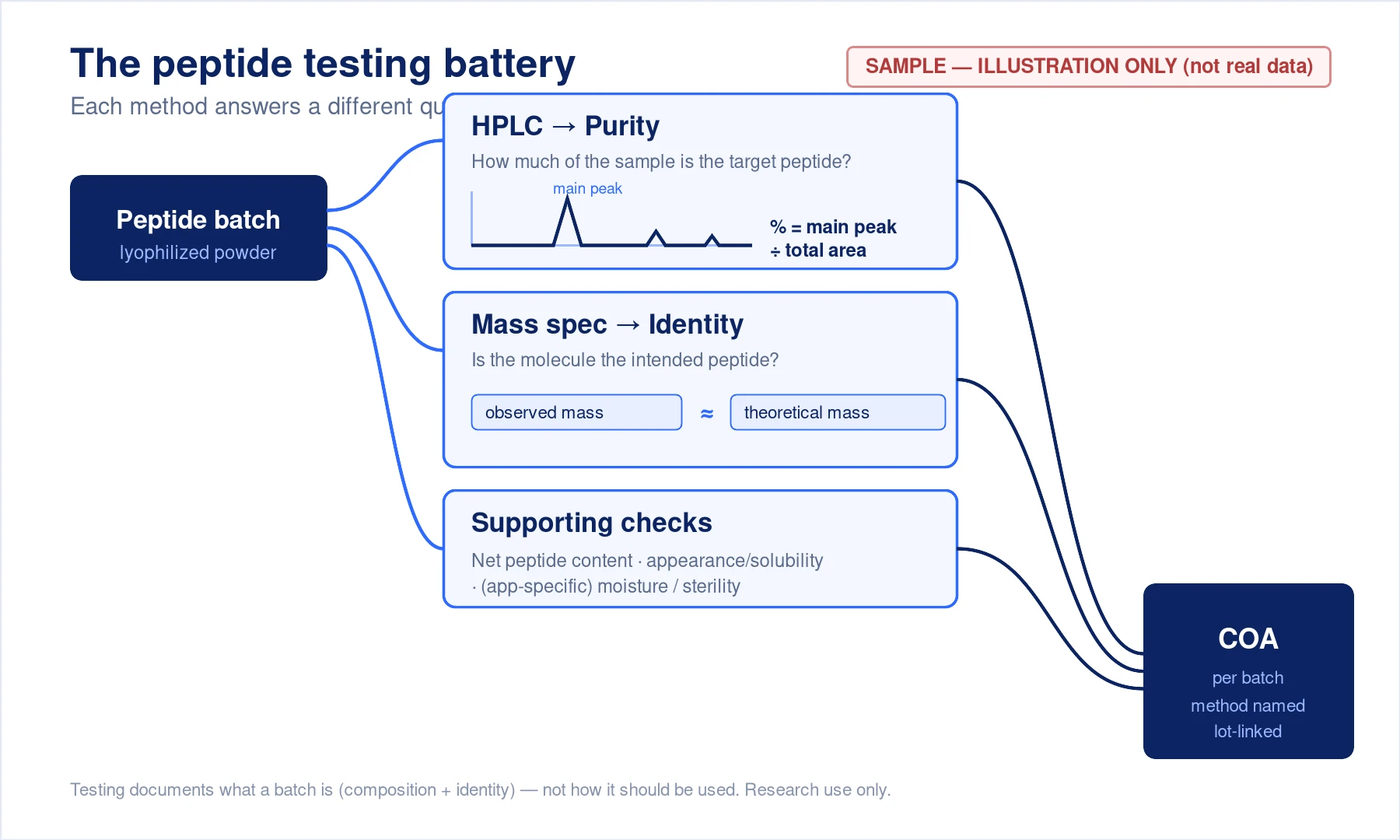
There is no single "peptide test." Characterizing a peptide batch means running a small, complementary battery of analytical methods, because no one method answers every question. In practice the core of that battery is two techniques: high-performance liquid chromatography (HPLC), which measures how pure a sample is, and mass spectrometry (MS), which confirms the identity of the molecule. Around those two sit supporting measurements — net peptide content, appearance and solubility, and, for particular applications, moisture or sterility checks. The results from each method are then gathered, batch by batch, into a Certificate of Analysis. The rest of this article walks through the battery method by method, and closes with how the pieces come together on a certificate.
HPLC: Measuring Purity
Purity almost always comes from reverse-phase HPLC. The dried sample is dissolved and pushed under high pressure through a column packed with a hydrophobic stationary phase (commonly a C18-bonded silica). A mobile phase — typically a gradient of water and acetonitrile, each containing a small amount of an acid modifier such as trifluoroacetic acid — carries the sample through. Components separate according to how strongly they interact with the column: less-retained species leave first, more-retained species later. As each component elutes it passes a detector, usually a UV detector reading the peptide bond at around 214 nm, and registers as a peak on a plot of signal against time — the chromatogram.
The purity percentage is a calculation of areas. The software integrates the area under each peak and divides the area of the main (target) peak by the total area of all detected peaks. "99% by HPLC" therefore means the target peptide accounts for roughly 99% of the detected peptide signal, with the remainder distributed among other detectable species. Two properties follow from this and are worth keeping in mind when reading any purity figure. Purity is a relative measurement — a proportion of detected material, not an absolute count of molecules — and it is method-dependent, since column chemistry, gradient, and detection wavelength all influence the result. This is exactly why a purity number only means something alongside the method that produced it, a point we cover in depth in the companion article on what a purity percentage really measures.
Mass Spectrometry: Confirming Identity
HPLC can show that a sample is overwhelmingly one component without proving which component it is. Establishing identity is the job of mass spectrometry, which measures a molecule's mass with high precision. Two ionization approaches dominate peptide work. ESI (electrospray ionization) sprays the dissolved sample into charged droplets and is frequently paired with liquid chromatography as LC-MS; it tends to produce multiply charged ions and is well suited to routine, sensitive analysis. MALDI-TOF (matrix-assisted laser desorption/ionization, time-of-flight) embeds the sample in a matrix and ionizes it with a laser pulse; it typically produces singly charged ions, which can make the resulting mass reading straightforward to interpret. Broadly, MALDI tends to favour speed and throughput while ESI tends to favour sensitivity — complementary tools rather than competitors.
However the ion is produced, the logic is the same: the instrument reports an observed mass, which is compared against the theoretical mass calculated from the peptide's amino-acid sequence. When the two agree within the expected tolerance, that supports the conclusion that the material is the intended peptide. Tolerances vary with the instrument. A review of protein identification by mass spectrometry reports delayed-extraction MALDI-TOF with a reflectron giving better than 50 ppm mass accuracy, quadrupole orthogonal-acceleration TOF around 5 ppm when well calibrated, and Fourier-transform MS approaching 1 ppm, and tighter tolerances are better at catching subtle errors such as a single wrong residue. Where sequence-level confirmation is needed, tandem mass spectrometry (MS/MS) fragments the peptide and reads the fragments to corroborate the order of the amino acids. The essential point is that identity and purity are different questions answered by different instruments: HPLC asks "how much of the sample is one component?" and MS asks "what is that component?" Pairing the two is not a modern convention — a 1991 survey of quality control in Fmoc peptide synthesis recommended a minimum analytical sequence of exactly this shape, HPLC together with mass spectrometry, after documenting synthesis failures such as double additions of a single amino acid and incomplete deblocking that a single method can miss.
Supporting Measurements
Beyond purity and identity, a full characterization may include several supporting checks — described here purely as analytical measurements. Net peptide content quantifies how much of the powder's weight is actually peptide, as opposed to bound water, counter-ions (such as trifluoroacetate or acetate), and residual salts; it is a separate figure from purity, and it is normal for a lyophilized powder to be highly pure yet contain a meaningful non-peptide fraction by weight. Appearance and solubility are recorded as basic physical descriptors of the material. For specific applications, laboratories may add moisture (water content) determination or, where relevant, endotoxin or sterility testing. These supporting methods round out the picture of what a batch contains; they are measurements of the material, not instructions about handling it.
In-House vs Third-Party Testing
Testing can be performed by the manufacturer's own laboratory (in-house) or by an independent laboratory with no stake in the result (third-party). Both can be technically rigorous. What independence adds is the removal of any commercial incentive from the reported outcome: a third-party COA describes the batch as an outside analyst measured it. In the Canadian context, independent peptide-testing services do exist, which makes third-party verification a practical option for researchers who want an outside read on a specific lot. The distinction is about who ran the analysis and what documentation accompanies it, not about the underlying chemistry — an in-house HPLC run and a third-party HPLC run measure the same thing the same way. Read either as what it is: a report on the tested batch, most useful when the method is named and the result is tied to a specific lot.
How the Results Become a COA
Individually, each method produces a number or a spectrum. A Certificate of Analysis is where those individual results are compiled for a single batch: it typically records the compound and batch/lot identifier, the analytical methods used, the HPLC purity result (often with the chromatogram or the calculated percentage), and the MS identity result as observed versus theoretical mass, sometimes alongside net peptide content and physical description. The certificate's value comes from that linkage — each figure is attached to the method that produced it and to the specific lot it describes, rather than being a generic claim. For a field-by-field walkthrough of a certificate, see our guide on how to read a peptide COA.
What Testing Does Not Establish
Taken together, this battery establishes two things about a specific batch: its composition (how much of the detected material is the target, and how much of the powder is peptide) and its identity (that the target is the intended molecule). That is a great deal of useful information, and it is also the limit of what analytical testing reports. A COA and its underlying tests do not establish that a compound is safe, suitable, or appropriate for any particular application; those are separate questions that analytical chemistry does not answer. Reading test results well means holding both halves in view — taking the composition and identity data at face value, and not stretching them into conclusions about fitness for purpose that the methods were never designed to support.
How BME Health Tests Each Batch
BME Health's documentation follows the structure above. Each batch is tested before it is listed, and the results are recorded against that specific batch rather than carried over from a previous lot. Purity and identity are verified using standard analytical methods appropriate to each compound, including HPLC where applicable, and compiled into a per-batch Certificate of Analysis that names the method used — so every figure travels with the evidence behind it. You can see the full approach on the Quality & Testing page, read the companion guides on how to read a peptide COA and what ≥99% purity really means, or browse the documented catalog.
Frequently Asked Questions
How are research peptides tested?
With a standard battery of analytical methods: HPLC measures purity (how much of the sample is the target peptide), mass spectrometry confirms identity (that the molecule is the intended one), and supporting checks such as net peptide content describe the powder's makeup. The results are compiled per batch into a Certificate of Analysis.
What is the difference between HPLC and mass spectrometry testing?
HPLC separates a sample and measures how much of it is the target versus other detectable species — a purity measurement. Mass spectrometry measures the molecule's mass and compares it to the theoretical value to confirm identity. They answer different questions and are used together.
What does "third-party" peptide testing mean?
It means the analysis was run by an independent laboratory with no commercial interest in the outcome, so the reported result reflects the batch as an outside analyst measured it. It describes who performed the testing and the documentation attached to it, not a different chemistry.
Does a Certificate of Analysis prove a peptide is safe to use?
No. A COA reports composition and identity for a tested batch. It does not establish safety, suitability, or fitness for any purpose — those are separate questions that analytical testing does not address.
What is net peptide content, and why is it tested separately?
Net peptide content measures how much of the powder's weight is peptide versus water, counter-ions, and salts. It is separate from purity: a sample can be very pure yet have a net content below 100% of the powder mass, which is normal for a lyophilized powder.
The Takeaway
"Tested" is not one measurement but a coordinated set: HPLC for purity, mass spectrometry for identity, and supporting checks for the rest — each answering a narrow question, all compiled per batch into a Certificate of Analysis. Understanding what each method measures, and what it deliberately leaves out, turns a short spec line into something you can actually read. And it clarifies the boundary that matters most: testing documents what a batch is, not how it should be used.
Sources
- Sigma-Aldrich (Merck). Peptide Sample Amount Determination. Purity determined by HPLC with detection at 214 nm where the peptide bond absorbs; the impurity fraction comprises deletion, truncation and incompletely deprotected sequences; purity does not account for water and salts present in the sample. View source
- National Cancer Institute, Nanotechnology Characterization Laboratory. Determination of Water Content using the Karl Fischer Coulometric Method. NCBI Bookshelf. View source
- Baldwin MA. Protein identification by mass spectrometry: issues to be considered. Molecular & Cellular Proteomics 2004;3(1):1–9. Instrument-dependent mass accuracy, and the comparison of observed against theoretical mass. PMID 14608001 · doi:10.1074/mcp.R300012-MCP200 · full text
- Fontenot JD, Ball JM, Miller MA, David CM, Montelaro RC. A survey of potential problems and quality control in peptide synthesis by the fluorenylmethoxycarbonyl procedure. Peptide Research 1991;4(1):19–25. Recommends HPLC together with mass spectrometry as a minimum analytical quality-control sequence. PMID 1802234 · abstract
- BME Health. Quality & Testing — per-batch testing and batch-linked Certificates of Analysis. View page
External sources verified to resolve on 28 July 2026; the two mass-spectrometry sources added 17 August 2026 and verified that day. Method tolerances and acceptance criteria are set by the testing laboratory rather than by a single universal standard.
BME Health supplies research compounds for laboratory use only. This article is educational and does not describe or recommend any use of any compound. See the Research Use Disclaimer.