Almost every research-peptide product page carries a purity figure — "≥99%," "98%," "≥95%." It looks like a simple quality score, and it is often read as one: higher number, better product. That reading is incomplete.
A purity percentage is a precise, narrow measurement of one thing — how much of a tested sample is the target molecule — and understanding exactly what it captures (and what it leaves out) is what separates an informed reading of a specification from a guess. This guide explains what a peptide purity percentage actually measures, how the number is produced, how it differs from two things it is easily confused with — identity and net peptide content — and what the common purity tiers signify. Everything below is written for research and laboratory context. BME Health supplies research compounds for laboratory use only, and this article is about interpreting documentation, not about using any compound.
What a Peptide Purity Percentage Actually Measures
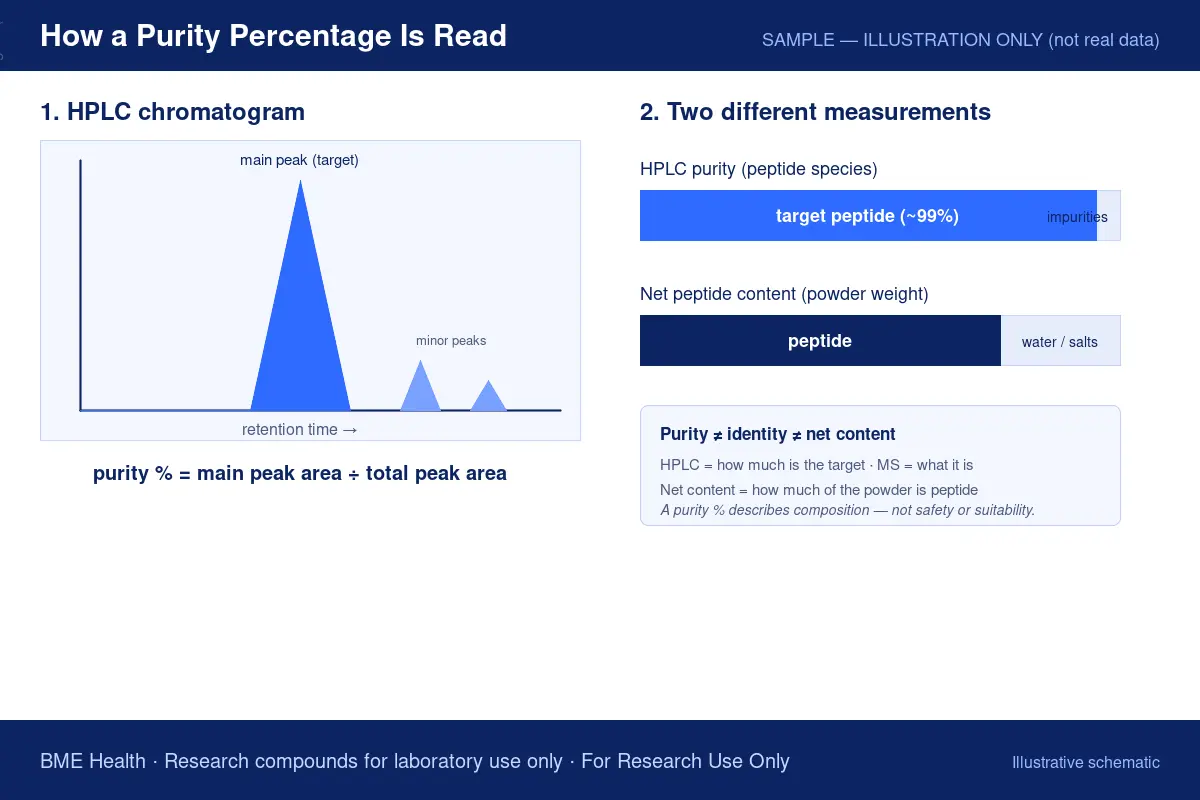
In peptide work, a purity percentage almost always comes from HPLC — high-performance liquid chromatography. An HPLC run pushes the dissolved sample through a column that separates its components by their chemical properties (in reverse-phase HPLC, by hydrophobicity). As each component leaves the column it passes a detector — typically a UV detector reading the peptide backbone at around 214 nm — and registers as a peak on a plot of signal versus time called a chromatogram.
The purity percentage is then a matter of areas. The software integrates the area under each peak and divides the area of the main (target) peak by the total area of all detected peaks. A result of "99% by HPLC" means the target peptide accounts for about 99% of the detected signal, with the remaining ~1% distributed among other detectable species. Two consequences follow directly. First, purity is a relative measurement of detected material, not an absolute count of molecules. Second, it is method-dependent: the same sample can return slightly different numbers under different column chemistries, gradients, or detection wavelengths, which is why a purity figure only means something alongside the method that produced it — and why a credible Certificate of Analysis names that method.
Purity Is Not Identity
The most important thing a purity percentage does not do is confirm what the molecule is. HPLC tells you that one component dominates the sample; it does not, on its own, prove that the dominant component is the sequence on the label. A sample could be 99% pure and still be the wrong peptide — a very clean preparation of the wrong thing.
Identity is established by a different method. In peptide work this is commonly mass spectrometry (MS), which measures the molecule’s mass: the observed mass is compared against the theoretical mass calculated from the sequence, within a tolerance the testing laboratory specifies rather than one fixed by any single universal standard. How tight that tolerance can be is a property of the instrument — a review of protein identification by mass spectrometry reports better than 50 ppm for MALDI-TOF with a reflectron, and around 1 ppm for Fourier-transform MS. For a field-by-field walkthrough of where these appear on a certificate, see our guide on how to read a peptide COA.
Purity Is Not Net Peptide Content
A second common confusion is between purity and how much peptide is actually in the vial. These are separate measurements. Purity describes the composition of the peptide-related material — how much of the detected peptide signal is the target versus related impurities. Net peptide content describes how much of the total powder mass is peptide at all, as opposed to bound water, counter-ions, and residual salts left from synthesis and purification.
The two can diverge substantially. A preparation can be highly pure by HPLC and still have a net peptide content well below 100% of the powder weight, because a lyophilized (freeze-dried) powder ordinarily includes some moisture and counter-ions such as trifluoroacetate or acetate. The weight involved is not trivial: a 2025 analysis of seven synthetic peptides calculated trifluoroacetate at roughly 22–35% of the salt weight, with chloride reaching about 10% in exchanged forms. This is normal and expected; it is not a sign of a problem, and it is why the labeled powder mass and the peptide mass are not the same figure. When it is reported, net peptide content is the number that describes the powder's makeup by weight — a different question from the purity percentage's chemical homogeneity.
What the Impurity Fraction Contains
The small remainder that is not the target peptide is not random dirt. In peptides made by solid-phase synthesis, the impurity fraction is mostly a predictable set of structurally related species: truncation sequences (chains that stopped early) and deletion sequences (missing an internal residue from an incomplete coupling step); oxidized variants, common where methionine or cysteine is present, which carry a mass increase of about 16 Da per oxidized residue; and deamidated variants, where asparagine or glutamine has converted to aspartate or glutamate, adding roughly 1 Da. Because these are chemically similar to the target, they tend to elute near it and are the reason ultra-high purity is technically demanding. For the purpose of reading a specification, the useful point is simply that the "impurity" percentage is composition information — a description of what else was detected — and nothing more.
What 95%, 98%, and 99% Signify
Research peptides are commonly offered at tiers around ≥95%, ≥98%, and ≥99%. These describe the degree of refinement of the preparation, not a benefit. ≥95% means roughly 5% or less of the detected peptide material is something other than the target. ≥98% narrows that to about 2% or less. ≥99% narrows it further to about 1% or less, which generally requires more extensive purification to reach.
These thresholds are labels suppliers commonly use, not a formally defined or standardised grading system. No single authority fixes what a given percentage must mean, so the figure is only meaningful alongside the method that produced it.
It is worth being precise about what climbing this scale does and does not represent. A higher tier means a cleaner composition and typically reflects additional purification effort (which is also why higher tiers usually cost more). It is not, by itself, a statement that a compound will behave any particular way in an experiment; that depends on the application, the method, and factors a purity number does not capture. A useful habit is to read the tier together with the underlying data — the named method and, where provided, the chromatogram — rather than treating the percentage as a standalone score.
What "Research Grade" Means
Alongside a purity tier you will often see the phrase “research grade.” It is worth being clear that this is not a formally defined regulatory category — it is industry shorthand describing intended use and level of oversight rather than a specific number or certification. In general usage it indicates material prepared for laboratory research use only, supplied with analytical quality control such as HPLC purity and MS identity, but without the regulatory documentation, sterility and stability programme associated with pharmaceutical or GMP manufacturing. Because the term is not standardised, what it covers can vary between suppliers — which is why the underlying analytical data matters more than the label. Research grade does not imply lesser chemical purity; a research-grade peptide can be chemically very pure. BME Health supplies research compounds for laboratory use only, and labels them “for research use only” to mark that scope.
What a Purity Number Does Not Tell You
Pulling the threads together, a purity percentage is powerful because it is narrow. Reading it well means holding its limits in view. It is composition, not fitness for purpose — a purity figure does not establish that a compound is safe, suitable, or appropriate for any application; those are separate questions a percentage cannot answer. It is not identity — purity without a matching identity measurement (MS) is an incomplete picture. It is not net content — purity says nothing about how much of the powder's weight is peptide versus water and salts. And it is method- and batch-specific — a number without a named method, or applied to a different lot than the one tested, is weaker than one with full, batch-linked detail.
Keeping these in mind prevents the most common misread: treating "≥99% pure" as an overall seal of quality or suitability, when it is strictly a statement about how much of one tested sample is the target molecule.
How BME Health Documents Purity
BME Health's documentation maps onto the distinctions above. Each batch is purity-tested before it is listed, and the result is recorded against that specific batch rather than carried over from a previous lot. Purity and identity are verified using standard analytical methods appropriate to each compound, including HPLC where applicable, and the results are compiled into a per-batch Certificate of Analysis that names the method — so the purity percentage always travels with the evidence behind it. In other words, the numbers this article explains are exactly what a BME Health specification is built to show. You can see the full approach on the Quality & Testing page, read the companion guide on how to read a peptide COA, or browse the documented catalog.
Frequently Asked Questions
What does "≥99% purity" mean on a research peptide?
By the stated method (usually HPLC), the target peptide accounts for at least about 99% of the detected peptide material in the tested batch, with roughly 1% or less being related impurities. It describes composition only — not safety, suitability, or any outcome.
Is a higher purity percentage always "better"?
A higher tier means a cleaner composition and usually more purification effort. Whether a given tier matters depends on the application and method; the percentage itself is not a statement of performance, and it should be read together with the named method and, where available, the chromatogram.
Why is purity different from net peptide content?
Purity describes how much of the detected peptide is the target versus related impurities. Net peptide content describes how much of the total powder weight is peptide versus water, counter-ions, and salts. A sample can be high in purity yet have a net content well below 100% of the powder mass — this is normal for a lyophilized powder.
Does a purity percentage confirm the peptide's identity?
No. Purity (HPLC) shows how much of the sample is one dominant component; identity (mass spectrometry) confirms that the component is the intended molecule. A complete specification reports both.
What does "research grade" mean?
It signals material prepared for laboratory research use only, with analytical QC (typically HPLC and MS) but without pharmaceutical/GMP regulatory documentation. It is a statement about intended use and oversight, not a specific purity number.
The Takeaway
A purity percentage is one of the most useful figures on a research-peptide specification — as long as it is read as what it is: a method-dependent, batch-specific measure of how much of a tested sample is the target molecule. It is not identity, it is not net content, and it is not a verdict on safety or suitability. Read it alongside the identity confirmation, the net content, and the named method, and the number becomes genuinely informative.
Sources
- Sigma-Aldrich (Merck). Peptide Sample Amount Determination. Purity determined by HPLC with detection at 214 nm where the peptide bond absorbs; the impurity fraction comprises deletion, truncation and incompletely deprotected sequences; purity does not account for water and salts present in the sample. View source
- Mueller LK, Baumruck AC, Zhdanova H, Tietze AA. Challenges and Perspectives in Chemical Synthesis of Highly Hydrophobic Peptides. Front Bioeng Biotechnol. 2020;8:162. doi:10.3389/fbioe.2020.00162 (PMID 32195241). View source
- Erckes V, Streuli A, Chamera Rendueles L, Krämer SD, Steuer C. Towards a Consensus for the Analysis and Exchange of TFA as a Counterion in Synthetic Peptides and Its Influence on Membrane Permeation. Pharmaceuticals (Basel) 2025;18(8):1163. Counter-ion contribution to peptide salt weight. PMC12389442 · doi:10.3390/ph18081163
- Baldwin MA. Protein identification by mass spectrometry: issues to be considered. Molecular & Cellular Proteomics 2004;3(1):1–9. Instrument-dependent mass accuracy behind an identity confirmation. PMID 14608001 · doi:10.1074/mcp.R300012-MCP200
- BME Health. Quality & Testing — per-batch testing and batch-linked Certificates of Analysis. View page
All external sources verified to resolve on 28 July 2026. Purity tiers and the term “research grade” are described as common industry usage rather than standardised definitions, because no single standards body defines them.
BME Health supplies research compounds for laboratory use only. This article is educational and does not describe or recommend any use of any compound. See the Research Use Disclaimer.