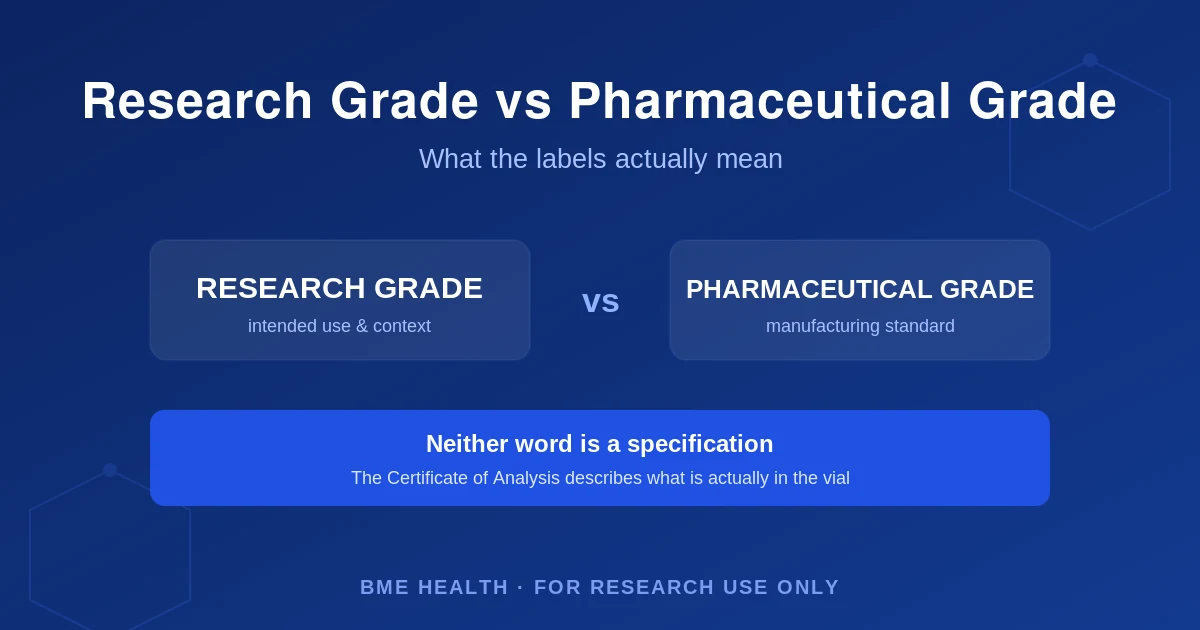
"Research grade." "Pharmaceutical grade." The words appear on labels and product pages as if they were precise specifications — a higher number you could compare at a glance. They are not. They describe an intended use and a manufacturing context, not a measured quality, and in the research-compound market they are used loosely enough that the word alone tells you very little. What tells you something is the documentation behind it.
This guide explains what each grade label conventionally means, why there is no single standard for them, and why the reliable way to compare materials is their documentation rather than their grade word. Everything below is about terminology and documentation. BME Health supplies research compounds for laboratory use only, and this article explains what the labels mean — it does not describe or recommend any use, preparation, or administration of any compound.
The Short Answer
A "grade" is a label about intended use and manufacturing context — not a purity figure and not a quality score. "Research grade" signals a material intended for laboratory research use only. "Pharmaceutical grade" points to the standards used to make medicines. Neither word, on its own, tells you how pure a specific batch is or what is actually in a particular vial. Those facts come from measurement, recorded on a Certificate of Analysis.
The practical consequence is simple: two labels that use different grade words can sit on materials whose real, measured specifications you cannot compare until you read their documentation. Treating the grade word as the specification is the mistake this article is meant to head off.
What "Research Grade" Conventionally Means
"Research grade" is a labelling convention that indicates a material is intended for laboratory research use only — not for human or veterinary use. It communicates a category and an intended context, and it carries the research-use framing that governs how such materials are supplied and handled.
What "research grade" is not is a single, legally standardised specification. There is no universal rulebook that fixes exactly what the phrase guarantees across every supplier, which is precisely why it should be read as a use-and-context label rather than a quality metric. A research-grade compound can be highly pure and thoroughly characterised — but you learn that from its purity figure and its documentation, not from the phrase itself. The word sets the context; the Certificate of Analysis supplies the substance.
What "Pharmaceutical Grade" Conventionally Means
"Pharmaceutical grade" generally refers to material manufactured and documented to the standards used for medicines. In practice that points to two things: conformance to a pharmacopoeia monograph — a published specification such as those in the United States Pharmacopeia (USP) — and production under Good Manufacturing Practice (GMP), the regulated manufacturing framework for drug products.
The important thing to understand is what kind of concept this is. "Pharmaceutical grade" is a manufacturing-and-regulatory term tied to the production of drugs for human use. It belongs to the world of approved medicines. That is why it should never be read, on a research compound, as an implication that the compound is a medicine, is approved, or is intended for human or veterinary use — research compounds are supplied for laboratory use only and are not drugs. The term describes a manufacturing standard used in medicine; it does not convert a research material into one.
"Grade" Is Not "Purity" — or "Content"
Because grade words sit close to the numbers that actually matter, it is worth separating them cleanly.
Purity is a measured percentage — typically by HPLC — describing how much of the peptide present is the correct target molecule rather than related impurities. It is explained in the guide on what a purity percentage really means, and it is a specific number for a specific batch, not something a grade word can stand in for.
Net peptide content is a different measured figure again: how much of the weighed powder is actually peptide, as opposed to counter-ions, salts, and residual water — covered in the guide on net peptide content. And identity — confirming the molecule is what it claims to be — is established by methods such as mass spectrometry, described in how research peptides are tested.
None of those three measured facts is contained in the word "grade." A grade label describes an intended category; purity, content, and identity describe the actual material. When people ask which is "better," research grade or pharmaceutical grade, they are usually reaching for a quality comparison that the grade words cannot answer — the answer lives in the measured specifications, not the label.
The Label Is Not the Guarantee — the COA Is
If the grade word is a category rather than a specification, then comparing two materials by their grade words compares their intended contexts, not their contents. The reliable comparison is their documentation.
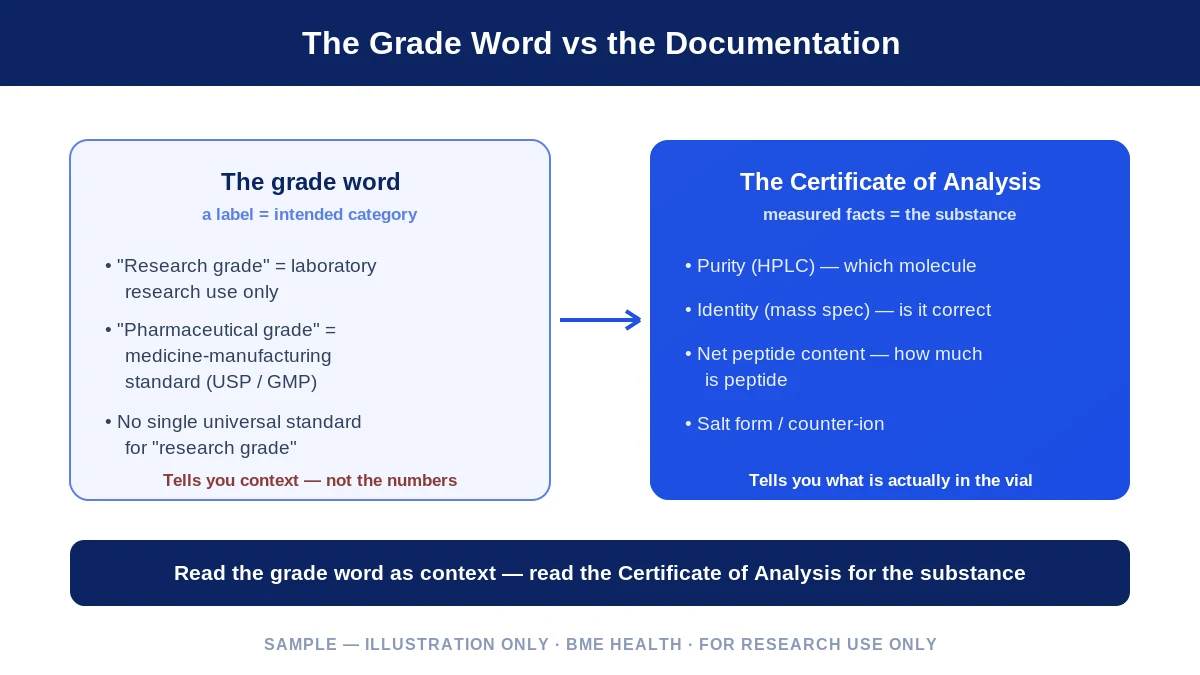
A per-batch Certificate of Analysis reports the purity figure, the identity confirmation, and, where applicable, the net peptide content and salt form — the measured values that actually characterise the batch in the vial. Two materials described with different grade words can only be compared meaningfully once those documents are on the table. This is why a documentation-forward approach treats the COA, not the grade label, as the source of truth: the label states an intention, the certificate states a result. Where a genuine standard is referenced — a specific pharmacopoeia monograph, for instance — that reference is only informative because it points to a defined, published specification, which again is a documentation question rather than a marketing word.
How BME Health Approaches Grade and Documentation
BME Health supplies research compounds for laboratory use only, and its approach is deliberately documentation-first rather than grade-word-first. Each batch is tested before it is listed — purity by HPLC where applicable and identity by mass spectrometry — and the results are compiled into a per-batch Certificate of Analysis, so the specification travels with the evidence behind it rather than resting on a label. The point of that approach is exactly the point of this article: the useful, comparable facts about a material are its measured specifications, not the grade word printed beside them. You can see the overall approach on the Quality & Testing page, read the companion guides on what ≥99% purity really means and net peptide content, or browse the documented catalog.
Frequently Asked Questions
What does "research grade" mean for a peptide?
It is a labelling convention indicating a material is intended for laboratory research use only, not for human or veterinary use. It is not a standardised, legally defined specification on its own, so the meaningful information is the per-batch documentation behind it — the purity, identity, and content figures on a Certificate of Analysis.
What does "pharmaceutical grade" mean?
It generally refers to material manufactured and documented to the standards used for medicines — for example meeting a pharmacopoeia monograph (such as USP) and being produced under GMP. It is a manufacturing-and-regulatory concept tied to drug production for human use, so on a research compound it should not be read as implying the compound is approved or intended for human use.
Is "research grade" the same as low quality?
No. Grade labels describe intended use and manufacturing context, not a quality score. A research-use compound can be highly pure and thoroughly documented. Purity is a separate HPLC measurement, and net peptide content is a separate figure again. Quality is established by testing and documentation, not by the grade word.
Is there an official standard for these labels?
For research chemicals there is no single universal legal definition of "research grade," so its usefulness depends on the accompanying documentation. "Pharmaceutical grade" points to defined pharmacopoeia and GMP standards, but those belong to medicine manufacturing. Because the labels are used loosely, the reliable comparison between materials is their Certificates of Analysis.
What should I look at instead of the grade label?
The per-batch Certificate of Analysis: the HPLC purity figure, the identity confirmation, and, where reported, the net peptide content and salt form. Those measured values describe what is actually in the vial, whereas the grade word only describes an intended category.
The Takeaway
"Research grade" and "pharmaceutical grade" are labels about intended use and manufacturing context, not measured specifications. "Research grade" says a material is for laboratory use only; "pharmaceutical grade" points to the standards used to make medicines and belongs to that regulated world, not to research compounds. Neither word tells you the purity, the identity, or how much of the powder is peptide — and those are the facts that actually distinguish one material from another. Read the grade word as context, and read the Certificate of Analysis for the substance.
Sources
- Sigma-Aldrich (Merck). Peptide Sample Amount Determination. Purity determined by HPLC with detection at 214 nm where the peptide bond absorbs; the impurity fraction comprises deletion, truncation and incompletely deprotected sequences; purity does not account for water and salts present in the sample. View source
- Mueller LK, Baumruck AC, Zhdanova H, Tietze AA. Challenges and Perspectives in Chemical Synthesis of Highly Hydrophobic Peptides. Front Bioeng Biotechnol. 2020;8:162. doi:10.3389/fbioe.2020.00162 (PMID 32195241). View source
- Erckes V, Streuli A, Chamera Rendueles L, Krämer SD, Steuer C. Towards a Consensus for the Analysis and Exchange of TFA as a Counterion in Synthetic Peptides and Its Influence on Membrane Permeation. Pharmaceuticals (Basel) 2025;18(8):1163. Supports the point above that net peptide content is reduced by counter-ions: trifluoroacetate was calculated at roughly 22–35% of salt weight across seven peptides. PMC12389442 · doi:10.3390/ph18081163
- Baldwin MA. Protein identification by mass spectrometry: issues to be considered. Molecular & Cellular Proteomics 2004;3(1):1–9. Supports the point above that identity is established by mass spectrometry rather than by a grade word — observed mass compared against theoretical mass, to an accuracy set by the instrument. PMID 14608001 · doi:10.1074/mcp.R300012-MCP200
- BME Health. Quality & Testing — per-batch testing and batch-linked Certificates of Analysis. View page
All external sources verified to resolve on 28 July 2026. “Research grade” is industry shorthand rather than a formally defined regulatory category, so what it covers can vary between suppliers.
BME Health supplies research compounds for laboratory use only. This article is educational and does not describe or recommend any use, preparation, or administration of any compound. See the Research Use Disclaimer.