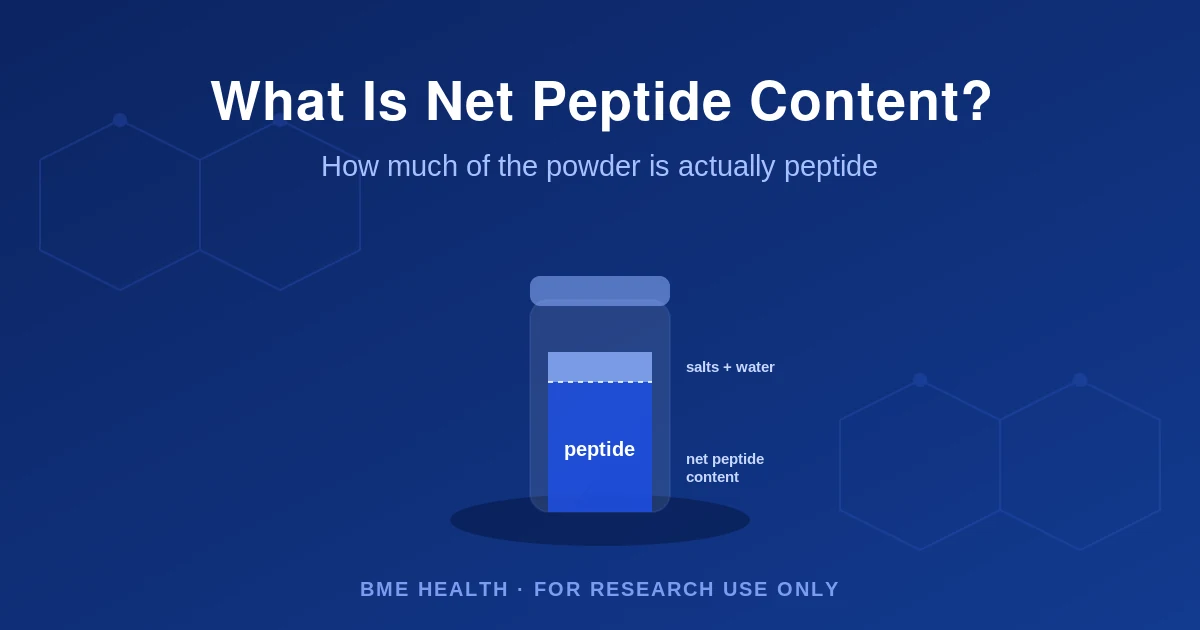
A vial labelled "10 mg" tells you how much powder is inside. It does not, by itself, tell you how much of that powder is peptide. Those are two different numbers, and the second one has a name: net peptide content. It is one of the more commonly misread figures on a Certificate of Analysis, and understanding it clears up a question that trips up a lot of otherwise careful readers.
This guide explains what net peptide content is, where the rest of the weight comes from, how it differs from purity, and how it is measured. Everything below is about interpreting documentation and analytical measurements. BME Health supplies research compounds for laboratory use only, and this article describes what the numbers mean — not how to use, prepare, or administer any compound.
The Short Answer
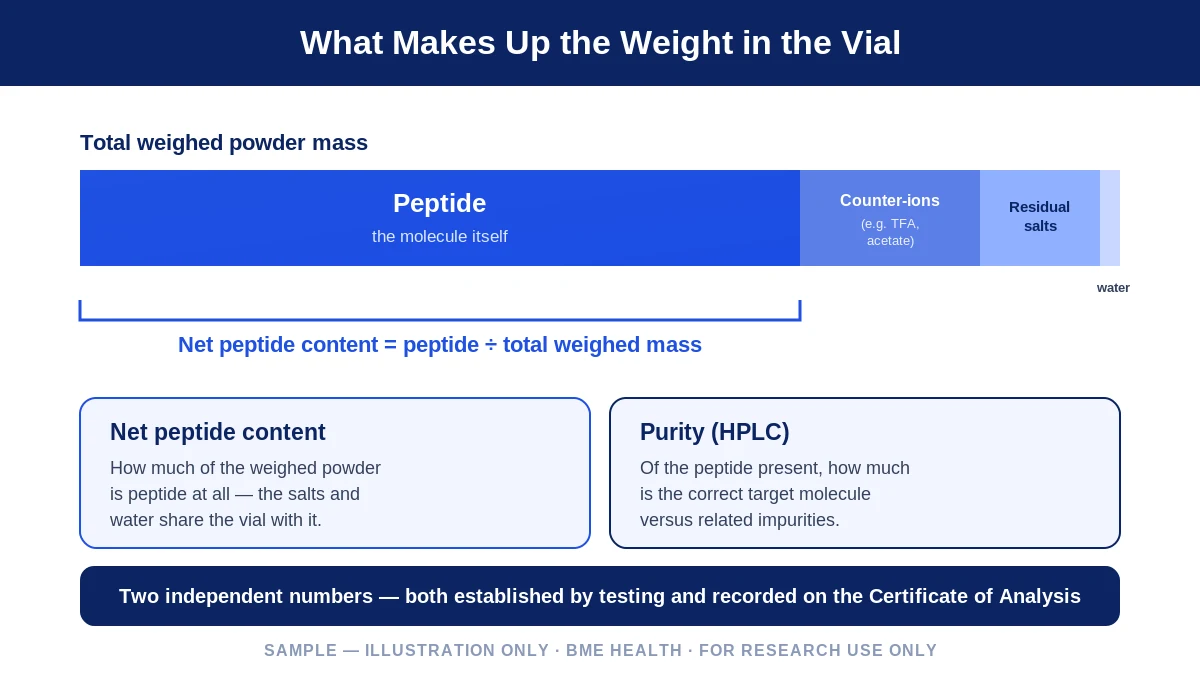
Net peptide content is the fraction of a powder's total weight that is actually peptide. When a peptide is supplied as a lyophilized powder, the dry solid in the vial is not pure peptide by mass. Alongside the peptide sit counter-ions, residual salts, and a small amount of bound water. The net peptide content states how much of the weighed powder is the peptide itself, usually expressed as a percentage of the total mass.
Put concretely: if a vial contains a nominal amount of powder and the net peptide content is, say, in the region of 80 percent, then roughly four-fifths of that weighed mass is peptide and the remainder is the associated salts and water. The exact figure is not assumed — it is established for the batch by measurement and reported on the documentation. The key idea is simply that powder weight and peptide weight are two distinct quantities, and net peptide content is the number that connects them.
Where the Rest of the Weight Goes
If a lyophilized powder is not 100 percent peptide by weight, it is worth being specific about what the other portion actually is. There are three usual contributors, and none of them indicates a problem — they are the normal, expected companions of a synthetic peptide solid.
Counter-ions. Most peptides carry charged groups, so they are isolated as a salt rather than as a free molecule, paired with an oppositely charged counter-ion. That counter-ion is part of the weighed mass but is not peptide.
Residual salts. Synthesis and purification leave behind small amounts of salts and buffer-derived material. These are minimised by purification but are not always zero, and what remains contributes mass.
Bound water. As covered in the companion article on lyophilized powder, secondary drying reduces moisture to a low level but usually leaves a little water bound to the material. That residual moisture, too, is weight that is not peptide.
Add these together and the peptide ends up being a fraction — typically a large one, but a fraction — of the total powder mass. This is ordinary for a freeze-dried salt-form peptide, which is exactly why a separate net-peptide-content figure exists rather than assuming the label weight is all peptide.
Net Peptide Content Is Not Purity
This is the distinction the whole topic turns on, and it is easy to blur because both are percentages that appear near each other on a Certificate of Analysis. They measure different things.
Purity answers: of the peptide that is present, how much is the correct target molecule rather than related impurities? It is typically determined by HPLC, which separates the target peptide from truncated sequences, deletion products, and other closely related species, and reports the target as a percentage of the peptide-related material. This is the figure explained in depth in the guide on what a purity percentage really means.
Net peptide content answers a different question: of the total powder you weighed, how much is peptide at all? It is about the salts and water that share the vial with the peptide, not about which peptide species are present.
The two are independent, and that independence is the point. A powder can be high purity and still have a net peptide content well below 100 percent — the peptide present is overwhelmingly the right molecule (high purity), yet a meaningful share of the weighed mass is counter-ion and water (lower net content). Conversely, a high net peptide content says nothing on its own about whether the peptide is the correct sequence. Reading a COA well means holding both numbers at once: purity tells you which molecule, net peptide content tells you how much of the weighed solid is that molecule. The broader set of checks these two sit within is covered in how research peptides are tested.
Salt Form and Counter-Ions
Because the counter-ion is usually the largest non-peptide contributor to the weight, the salt form of a peptide is worth understanding on its own terms.
When a peptide is purified by reversed-phase HPLC, the mobile phase very often contains trifluoroacetic acid (TFA), and the peptide tends to come off the process paired with trifluoroacetate as its counter-ion. TFA salt is therefore one of the most common forms in which research peptides are supplied. Acetate is another frequently encountered salt form. Different counter-ions have different masses, so the salt form directly affects how much of the powder's weight is counter-ion versus peptide — and therefore the net peptide content. The scale is measurable: a 2025 analysis of seven synthetic peptides calculated trifluoroacetate at roughly 22–35% of the salt weight, with chloride reaching about 10% in exchanged forms.
This is why a well-documented peptide states its salt form rather than leaving it implied: the salt form is part of the identity of what is in the vial and part of the explanation for the mass balance. It is a description of the material, not a handling instruction — the practical business of returning the powder to solution is a separate, downstream step outside the scope of this article and is introduced conceptually in the pieces on lyophilized powder and bacteriostatic water.
How Net Peptide Content Is Measured
Net peptide content is not read off a label — it is a measured quantity, established by methods that determine how much peptide is present independently of the total mass that was weighed out.
Amino acid analysis is a common reference approach. The peptide is hydrolysed into its constituent amino acids, those amino acids are separated and quantified, and the total is used to calculate the amount of peptide in the sample. Because it counts the amino acids themselves, it reports peptide mass without counting the salts and water that came along with it.
Nitrogen determination (for example, Kjeldahl-type methods) quantifies peptide by its nitrogen content, and quantitative UV or HPLC methods can be calibrated to report the amount of peptide present. Each of these is an analytical measurement of the peptide fraction, and each is reported with the assumptions and limitations of the method — there is no single universal figure, only a measured value for the batch. Dividing the measured peptide amount by the weighed powder mass yields the net peptide content that appears on the documentation.
A theoretical figure can also be calculated from the peptide's molecular weight and the number of counter-ions needed to neutralise it — a peptide of MW 1000 carrying two trifluoroacetate counter-ions works out at 1000 / 1228, or about 81%. That calculation assumes counter-ions are the only non-peptide component, which is why it is an estimate rather than a result: residual water, adsorbed solvents and trace substances are not in it. The practical consequence is worth stating plainly: net peptide content is a specification derived from testing, not an estimate. When it is present on a Certificate of Analysis, it reflects a measurement made on the batch.
Why It Appears on a Certificate of Analysis
A Certificate of Analysis exists to record what a batch actually is, and net peptide content belongs there for the same reason purity does: it turns an otherwise ambiguous label weight into a documented, measured quantity. Without it, "10 mg" is only a statement about powder. With it, the documentation makes explicit how much of that powder the testing found to be peptide.
For anyone comparing documentation across batches or suppliers, this is the figure that makes weights comparable on the same basis. It is also the reason the reference calculator and any concentration relationships are worked out from documented values rather than from the nominal label alone — the honest starting point is what the testing reports, not what the sticker rounds to. As with every other figure discussed here, net peptide content is a documentation and material-characterisation concept; it describes the batch, and says nothing about any use of the compound.
How BME Health Documents Net Peptide Content
BME Health supplies research compounds as lyophilized powders, documented at the batch level. Each batch is tested before it is listed — purity by HPLC where applicable and identity by mass spectrometry — and the results are compiled into a per-batch Certificate of Analysis so the specification travels with the evidence behind it. Net peptide content sits inside that same documentation-first approach: where it is reported, it is a measured characterisation of the material rather than an assumption drawn from the label. You can see the overall approach on the Quality & Testing page, read the companion guides on what ≥99% purity really means and what a lyophilized powder is, or browse the documented catalog.
Frequently Asked Questions
What is net peptide content?
Net peptide content is the proportion of a lyophilized powder's total weight that is actually peptide, as opposed to the counter-ions, residual salts, and bound water that also make up the solid. A vial labelled with a nominal milligram weight refers to the mass of powder; the net peptide content states how much of that mass is the peptide itself.
Is net peptide content the same as purity?
No. They answer different questions and are measured differently. Purity, typically reported by HPLC, describes what fraction of the peptide present is the correct target molecule rather than related impurities. Net peptide content describes how much of the total powder weight is peptide at all. A powder can be high purity and still have a net peptide content well below 100 percent because of salts and water.
Why is net peptide content less than 100 percent?
Because a freeze-dried peptide is not pure peptide by weight. Purification by reversed-phase HPLC commonly leaves counter-ions such as trifluoroacetate or acetate paired with the peptide, secondary drying leaves a small amount of bound water, and residual salts remain from synthesis. These add mass without being peptide, so the peptide is a fraction of the total — often reported somewhere in the range of roughly 70 to 90 percent for a salt-form powder, with the exact figure established by testing.
How is net peptide content measured?
By quantitative methods that determine the amount of peptide independently of the total weighed mass. Amino acid analysis, which hydrolyses the peptide and quantifies the released amino acids, is a common reference approach; nitrogen determination and quantitative UV or HPLC methods are also used. The measured peptide amount divided by the weighed powder mass gives the net peptide content, which is reported on the Certificate of Analysis.
What is a peptide counter-ion or salt form?
Many peptides carry charged groups, so they are isolated as a salt paired with a counter-ion. Trifluoroacetate (TFA) is common because trifluoroacetic acid is widely used in HPLC purification; acetate is another frequent form. The counter-ion is part of the powder's weight but is not peptide, which is one reason the net peptide content is below the total mass.
The Takeaway
Net peptide content is the answer to a question the label alone cannot settle: of the powder you weighed, how much is peptide? The rest — counter-ions, residual salts, and a little bound water — is the ordinary company a freeze-dried peptide keeps, and its presence is why a measured net-content figure exists in the first place. Read alongside purity, it completes the picture: purity tells you the peptide present is the right molecule, and net peptide content tells you how much of the weighed solid that molecule accounts for. Both come from testing, and both are recorded, as always, on the batch's Certificate of Analysis.
Sources
- Sigma-Aldrich (Merck). Peptide Sample Amount Determination. Purity determined by HPLC with detection at 214 nm where the peptide bond absorbs; the impurity fraction comprises deletion, truncation and incompletely deprotected sequences; purity does not account for water and salts present in the sample. View source
- National Cancer Institute, Nanotechnology Characterization Laboratory. Determination of Water Content using the Karl Fischer Coulometric Method. NCBI Bookshelf. View source
- Erckes V, Streuli A, Chamera Rendueles L, Krämer SD, Steuer C. Towards a Consensus for the Analysis and Exchange of TFA as a Counterion in Synthetic Peptides and Its Influence on Membrane Permeation. Pharmaceuticals (Basel) 2025;18(8):1163. Measured counter-ion contribution to peptide salt weight. PMC12389442 · doi:10.3390/ph18081163
- AmbioPharm Inc. How is theoretical net peptide content calculated? Manufacturer technical FAQ — the theoretical formula and its stated limits. View source
- BME Health. Quality & Testing — per-batch testing and batch-linked Certificates of Analysis. View page
All external sources verified to resolve on 28 July 2026. Net peptide content is reported only when a supplier measures it; it is not a universally required COA field.
BME Health supplies research compounds for laboratory use only. This article is educational and does not describe or recommend any use, preparation, or administration of any compound. See the Research Use Disclaimer.