Read enough Certificates of Analysis and a phrase starts appearing that nothing on the vial explains: TFA salt. Sometimes it is acetate salt, occasionally hydrochloride. It sits in the specifications alongside purity and identity as though everyone already knows what it means. It is not a purity grade, it is not a quality tier, and it is not a marketing term. It is a straightforward statement about what else is in the powder besides peptide — and it is one of the few COA fields that directly affects what the milligram figure on the label represents.
This article explains what a peptide salt form is, why trifluoroacetate is the default outcome of how research peptides are made, how much of a vial's weight a counter-ion can account for, and why an HPLC purity percentage does not reveal any of it. Everything here concerns chemistry and documentation. BME Health supplies research compounds for laboratory use only, and this article does not describe or recommend any use, preparation, or administration of any compound.
The Short Answer: The Counter-Ion Is Part of the Powder
A peptide salt form names the counter-ion paired with the peptide in the dry powder. Peptides carry charged groups — the N-terminus and residues such as arginine, lysine and histidine — and charged molecules are isolated as salts, not as bare ions. Something has to balance those charges, and whatever that something is becomes part of the solid you weigh out. Trifluoroacetate is the most common counter-ion for synthetic research peptides; acetate and chloride also occur.
The practical consequence is a weight consequence. The counter-ion contributes mass without being peptide, which is why the number of milligrams printed on a vial and the amount of peptide in that vial are two different quantities. That difference is measured and reported as net peptide content; the salt form tells you which species is responsible for a large part of the gap.
Why Are Synthetic Peptides Usually TFA Salts?
Because of how they are made and purified, not because anyone chose trifluoroacetate for its own sake.
Modern solid-phase peptide synthesis assembles the chain on a resin and then has to cut it off. Trifluoroacetic acid does that job. The same acid is then widely used as an ion-pairing reagent in reversed-phase liquid chromatography, the standard purification step, where it improves separation by pairing with the peptide's positively charged groups. As Erckes and colleagues put it in a 2025 review of counter-ion analysis, synthesis and purification via SPPS "strongly rely on trifluoroacetic acid (TFA) as a cleavage agent and ion-pairing reagent, respectively, resulting in peptides being obtained as TFA salts" (Erckes et al., 2025).
The final step is where it becomes permanent. When the purified solution is freeze-dried, the peptide and the trifluoroacetate come out of solution together: the same paper notes that "the lyophilization of peptide-containing solutions results in the formation of a peptide—TFA salt." So a TFA salt is not an additive or a contaminant introduced afterwards. It is the ordinary result of the process that produced the lyophilized powder in the vial.
How many counter-ions end up paired with each peptide tracks the sequence. The same study found a clear correspondence between the number of positively charged residues in a peptide and the number of counter-ions associated with it — a peptide with more basic residues carries more trifluoroacetate, which is why the salt fraction is sequence-dependent rather than a fixed number.
How Much of the Weight Is Counter-Ion?
Enough to matter, and the amount can be both calculated and measured.
The calculation is simple arithmetic. AmbioPharm, a peptide API manufacturer, sets out the theoretical form: divide the peptide's molecular weight by that molecular weight plus the number of bound counter-ions multiplied by the counter-ion's molecular weight, using 114 for trifluoroacetate and 59 for acetate. Their worked example is a 1,000 Da peptide with two positions available for a counter-ion, giving 1000 / (1000 + (2 × 114)) = 81% (AmbioPharm). In that example roughly a fifth of the powder's weight is counter-ion before anything else is accounted for.
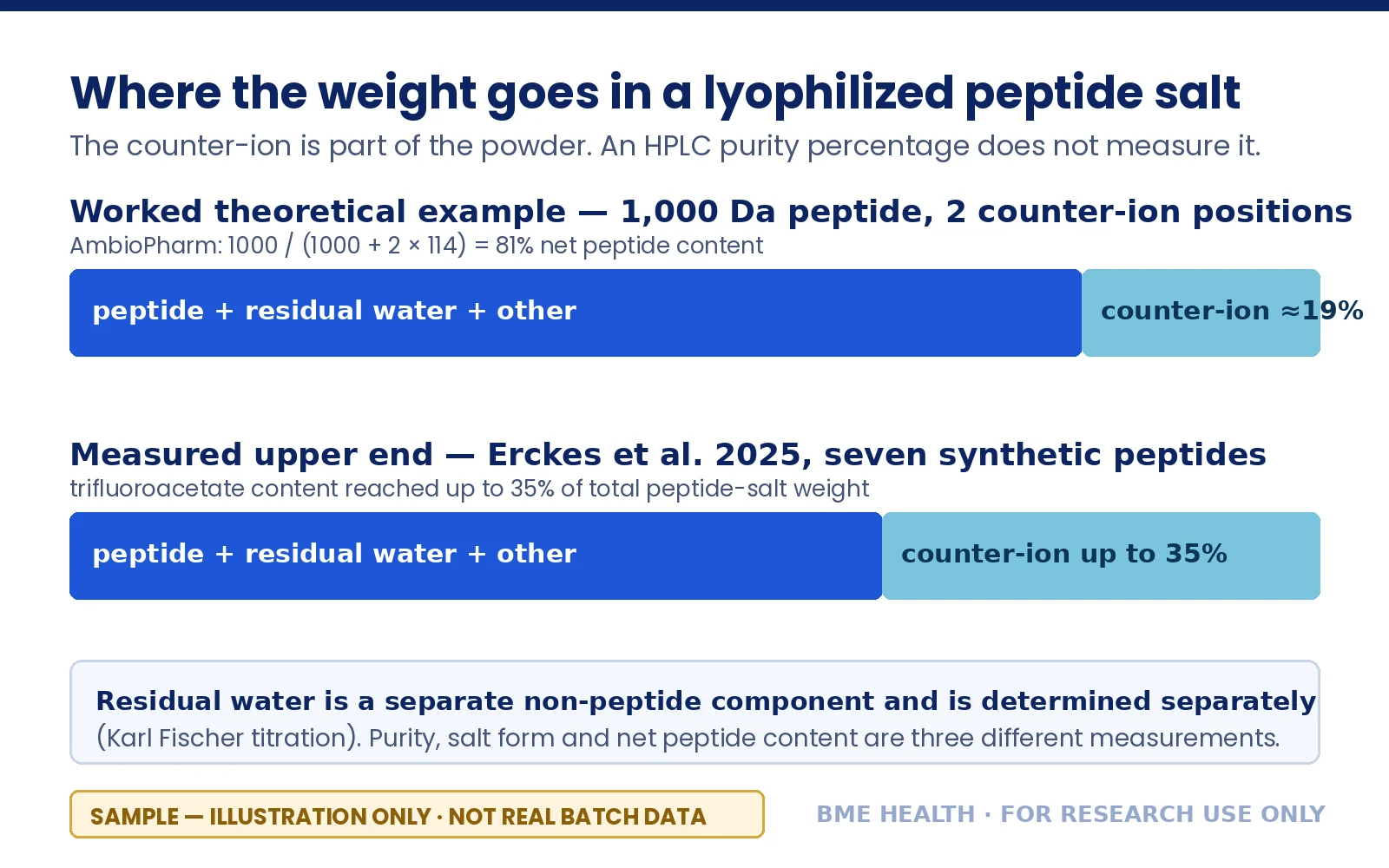
The measured figures run in the same range and sometimes higher. In the 2025 study, calculated trifluoroacetate weight percentages across the seven peptides examined ranged from 21.9% to 35.2%, and the authors report that in their measurements "the content of TFA− reached up to 35% and the content of Cl− reached up to 10% of total weight in peptide salts." For one model peptide immediately after purification they measured 0.333 ± 0.008 mg of trifluoroacetate per milligram of peptide salt.
Two cautions on those numbers. First, they describe the specific peptides in that study, not peptides in general — the fraction depends on the sequence, so the only figure that describes a particular batch is the one measured on that batch. Second, the counter-ion is not the only non-peptide component. AmbioPharm notes that a sample "can also contain residual water, adsorbed solvents and traces of other substances," and residual water in a freeze-dried solid is determined separately, by Karl Fischer titration. Salt and water together are why net peptide content is measured rather than assumed.
Why Doesn't the Purity Percentage Show the Salt?
Because purity and salt content are different measurements answering different questions, and the instrument used for purity is not looking for the counter-ion.
An HPLC purity figure is a comparison among the peptide-related species that absorb at the detection wavelength — typically 214 nm, where the peptide bond absorbs. It tells you what fraction of the peptide material present is the intended sequence rather than deletion, truncation or incompletely deprotected products. Sigma-Aldrich states the limit of that measurement directly: peptide purity "does not take into account water and salts that are usually present in the sample" (Sigma-Aldrich).
So a batch can be 99% pure and still be, say, a quarter counter-ion by weight, with no contradiction between the two statements. The 99% describes the peptide fraction's composition; the salt describes the powder's composition. This is the same distinction covered at length in what a purity percentage actually measures — and it is the single most common misreading of a Certificate of Analysis.
Where Salt Form Appears on a Certificate of Analysis
Salt form belongs in the identity and composition section of a COA rather than among the purity results, because it describes what the material is rather than how well it came out. In practice it appears in one of a few places: as part of the compound name ("peptide, TFA salt"), as a standalone counterion or salt-form line, or implicitly through a net peptide content figure that already accounts for it.
What a reader can reasonably do with it is limited but useful. If the COA states a salt form and a net peptide content, the two are consistent with each other and the net content is the figure that matters for how much peptide the vial holds. If the COA states a salt form but no net content, the salt form tells you the gap exists without telling you its size. If neither appears, the document is silent on the question — which is worth knowing, and is one of the specific things to check when reading a Certificate of Analysis.
There is no universal reporting standard that requires a counter-ion line, and this article does not claim one. What the literature does say is that it should be stated: the 2025 study concludes that "the salt choice should therefore be explicitly reported and considered in peptide-based studies." That is a recommendation from researchers about research practice, and it is the honest basis for saying salt form belongs on the paperwork.
Can the Counter-Ion Be Changed?
Yes — counter-ion exchange is a documented laboratory procedure, and it is routine enough that methods for it have been compared and validated.
The common approach is to dissolve the peptide salt in a dilute acid solution and freeze-dry it, repeating the cycle if needed, so that one counter-ion is progressively displaced by another. The 2025 study examined exactly this, exchanging trifluoroacetate for chloride across a range of dilute hydrochloric acid concentrations and monitoring what happened after each cycle. Residual counter-ion was quantified by three methods — 19F-NMR, FT-IR and HPLC with an evaporative light-scattering detector — each validated against ICH guidelines.
One result from that work is directly relevant to reading documentation. Across every exchange condition tested, the peptide's purity measured by HPLC-UV "was constantly above 96%", and no degradation products were observed. Changing the salt form did not change the purity. That is a clean demonstration of the point in the previous section: these are independent properties of the same powder, and a change in one is not a change in the other.
Whether a given batch has been exchanged is a documentation question, not something visible in a vial of white powder. If it matters, it has to be stated on the paperwork.
What the Salt Form Does Not Tell You
A counter-ion is a fact about composition, and it is easy to over-read. Specifically, the salt form does not tell you:
- How pure the peptide is. That is the HPLC figure, measured separately, as above.
- Whether the identity is correct. Identity is confirmed by methods such as mass spectrometry — see how research peptides are tested.
- Exactly how much peptide is in the vial. The salt form explains part of why the weighed mass exceeds the peptide mass; only a measured net peptide content quantifies it.
- That one salt form is "better" than another. They are different chemical species with different molecular weights. This article makes no claim about the suitability of any salt form for any purpose.
It also does not tell you anything about how a compound behaves in any living system, and nothing in this article should be read as suggesting otherwise. The scope here is what the powder is made of and how that is documented.
How BME Health Documents Batch Specifications
BME Health tests each batch before it is listed and links the results to that specific batch, with the Certificate of Analysis recording compound identity, purity percentage and testing method, using HPLC where applicable. That is the process described on the Quality & Testing page, and it is the reason the batch documentation — not the vial label — is where the composition of a given lot is established.
The general principle this article is really about: a milligram figure on a label is a weighed mass, and a weighed mass includes everything in the powder. The document that tells you what else is in there is the COA. You can see the overall approach on the Quality & Testing page or browse the documented catalog.
Frequently Asked Questions
What is a peptide salt form?
It describes which counter-ion is paired with the peptide in the dry powder. Peptides carry charged groups, so they are isolated as salts rather than as free molecules. Trifluoroacetate is the most common counter-ion for synthetic research peptides; acetate is another form that occurs. The counter-ion is part of the powder's weight but is not peptide.
What does "TFA salt" mean on a COA?
That the peptide is paired with trifluoroacetate counter-ions. Solid-phase synthesis uses trifluoroacetic acid as a cleavage agent and as an ion-pairing reagent in reversed-phase purification, so material is obtained as a TFA salt by default. Stating it on the COA tells you which non-peptide species contributes to the weighed mass.
How much of a vial's weight is counter-ion?
It depends on how many positively charged residues the sequence carries. In a 2025 study of seven synthetic peptides, calculated trifluoroacetate weight percentages ranged from about 22% to 35%, and measured trifluoroacetate content reached up to 35% of the total weight of the peptide salt. The figure for any specific batch comes from that batch's testing, not from a general rule.
Does the purity percentage include the salt?
No. An HPLC purity percentage compares the target peptide against other peptide-related species at the detection wavelength. Sigma-Aldrich states that peptide purity does not take into account water and salts usually present in the sample. A high purity figure says nothing about how much counter-ion is present.
Can the counter-ion be changed?
Yes. Counter-ion exchange is a documented procedure, typically dissolving the salt in a dilute acid and freeze-drying, sometimes over several cycles, with residual counter-ion quantified by 19F-NMR, FT-IR or HPLC-ELSD. In the 2025 study, HPLC-UV purity stayed above 96% throughout, which shows salt content and purity are independent.
The Takeaway
A peptide salt form is a statement about composition: which counter-ion is paired with the peptide, and therefore what a meaningful share of the powder's weight actually is. Trifluoroacetate is the usual answer for synthetic research peptides because trifluoroacetic acid does the cleaving and the ion-pairing during synthesis and purification, and freeze-drying locks the pairing in. Depending on the sequence, that counter-ion can account for something in the region of a fifth to a third of the weighed mass — a figure that can be calculated in theory and measured in practice, but only batch by batch.
The reason it belongs in your reading of a Certificate of Analysis is that the purity percentage will never show it. Purity describes the peptide fraction; salt form and net peptide content describe the powder. Read them as three separate answers to three separate questions, and the document stops being contradictory and starts being informative.
BME Health supplies research compounds for laboratory use only. This article is educational and does not describe or recommend any use, preparation, or administration of any compound. See the Research Use Disclaimer.
Sources
- Erckes V, Streuli A, Chamera Rendueles L, Krämer SD, Steuer C. Towards a Consensus for the Analysis and Exchange of TFA as a Counterion in Synthetic Peptides and Its Influence on Membrane Permeation. Pharmaceuticals (Basel). 2025;18(8):1163. PMC12389442 · doi:10.3390/ph18081163
- AmbioPharm. How is theoretical net peptide content calculated? Technical FAQ
- Sigma-Aldrich (Merck). Peptide Sample Amount Determination. Technical article
- National Cancer Institute, Nanotechnology Characterization Laboratory. Determination of Water Content using the Karl Fischer Coulometric Method. NCBI Bookshelf
- BME Health. Quality & Testing — batch testing and COA documentation process.