Open almost any research-peptide vial and you find not a liquid but a small white cake or fine powder clinging to the bottom of the glass. The label calls it "lyophilized." The word describes how the material was made and why it is shipped dry — and understanding it explains a lot about how a research compound is handled from the vial onward.
This guide explains what a lyophilized powder is, how the freeze-drying process works, and why research peptides are supplied in this form rather than as a ready-made solution. Everything below is about the material and the process. BME Health supplies research compounds for laboratory use only, and this article describes what the dry form is — not how to use, prepare, or administer any compound.
The Short Answer: A Freeze-Dried Solid
"Lyophilized" is the technical word for freeze-dried. Lyophilization is a drying process that removes water from a frozen material under vacuum, leaving behind a dry solid — usually a light, porous cake or a fine powder. The result is the same substance with almost all of its water taken out, in a form that is more stable to store and transport than the equivalent solution.
The distinctive thing about lyophilization is how the water leaves. Instead of boiling the water off with heat, the process freezes the material first and then removes the ice directly as vapour under vacuum, without ever passing back through the liquid phase. Because the material stays frozen and cold throughout, delicate molecules such as peptides and proteins are subjected to far less thermal and chemical stress than they would be during ordinary heat drying. That gentleness is the whole point.
How Lyophilization Works
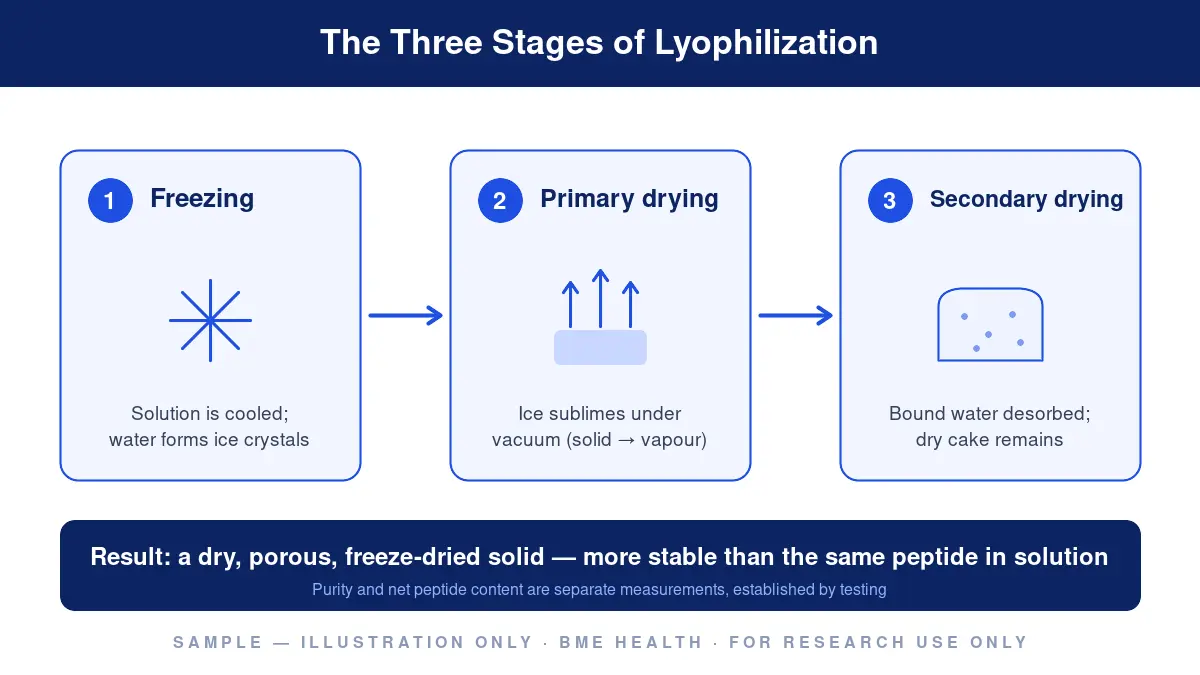
Freeze-drying is a standard laboratory and pharmaceutical unit operation, and it proceeds in three stages.
1. Freezing. The solution is cooled until the water in it crystallizes into ice and the dissolved material is locked in place around those ice crystals. How the material is frozen influences the structure of the final cake — the size and arrangement of the ice crystals set the network of pores that the later drying stages leave behind.
2. Primary drying (sublimation). The chamber pressure is lowered to a deep vacuum and a small amount of heat is supplied. Under these conditions the ice sublimes — it converts directly from solid to vapour without melting — and the water vapour is drawn off and trapped on a cold condenser. This stage removes the bulk of the water, the frozen "free" ice, and it is the longest part of the run. What remains is a dry but still slightly moist matrix in the shape of the frozen solution.
3. Secondary drying (desorption). Finally the temperature is raised modestly while the vacuum is maintained, and the water molecules still bound to the material are desorbed and removed. This drives the residual moisture down to a low level and yields the finished lyophilized cake. Even so, a small amount of bound water usually remains — a point that matters when we get to what the powder actually weighs.
The finished product is the same molecule that went in, now as a dry, porous solid that can be sealed in the vial for storage.
Why Research Peptides Are Freeze-Dried
The reason peptides so often arrive lyophilized comes down to stability in the dry state versus in water.
Peptides in solution are chemically busy. Water is a participant, not just a solvent: it enables reactions such as hydrolysis (cleavage of the peptide backbone) and contributes to processes like deamidation and oxidation that gradually alter a fraction of the molecules over time. A dissolved peptide also has to contend with the microbiological reality that water is a medium in which bacteria can grow. Take the water away, and most of that chemistry slows dramatically. A dry solid has far less molecular mobility and far less of the reactant — water — that many degradation pathways depend on, so a lyophilized powder is generally much more stable over time than the same peptide sitting in solution.
There is a practical logistics dimension too. A stable dry solid is lighter, is not at risk of freezing or leaking the way a liquid is, and tolerates shipping and handling conditions that a ready-made solution would not. For a supplier documenting and shipping many compounds, lyophilization is the form that keeps the material in a defined, stable condition from the lab to the vial on the shelf. This is closely related to why the accompanying diluent is a separate item rather than pre-mixed — a topic covered in the companion article on bacteriostatic water.
What a Lyophilized Peptide Looks Like
Inside the vial, a lyophilized peptide is typically a white to off-white cake or powder. It may appear as a solid "puck" that holds the shape of the frozen solution, as a fluffy or crystalline layer, or as a fine loose powder — and its apparent volume can look surprisingly small, because a few milligrams of peptide plus its associated salts simply do not occupy much space.
Appearance varies from compound to compound and batch to batch, and a few visual observations are worth putting in context. A collapsed or shrunken cake — where the porous structure has partly melted back on itself — is a cosmetic and process observation, not by itself a verdict on the chemistry; the identity and purity of the material are established by analytical testing, not by how the cake looks. Likewise, a very fluffy versus a dense cake reflects how the material was frozen and dried more than it reflects quality. The reliable statements about what is in the vial come from the Certificate of Analysis, not from a visual impression of the powder.
Lyophilized Is Not the Same as Pure — or "Full"
Two common misreadings are worth heading off, because the word "lyophilized" sits close to two different measurements.
Lyophilized describes the form, not the purity. Freeze-drying is a drying step; it does not by itself make a sample more or less pure. A lyophilized powder can be highly pure or not — that is a separate question answered by HPLC, and explained in depth in the guide on what a purity percentage really measures. "Lyophilized" tells you the material is a freeze-dried solid; the purity figure tells you how much of it is the target molecule.
A lyophilized powder is not 100% peptide by weight, either. Because secondary drying leaves a little bound water behind, and because synthesis and purification leave counter-ions (such as trifluoroacetate or acetate) and residual salts in the material, the mass of powder in a vial is not identical to the mass of peptide. How much of the powder's weight is actually peptide is a distinct measurement called net peptide content, which is described alongside the other analytical checks in how research peptides are tested. This is normal and expected for a freeze-dried powder — not a sign of a problem — and it is why the labelled powder mass and the peptide mass are two different numbers.
From Powder Back to Solution
A lyophilized powder is a starting point, not an endpoint: before the material can be analyzed or handled in most laboratory work, the dry solid has to be returned to solution — a step called reconstitution. Conceptually, that means adding a suitable sterile diluent so the peptide dissolves back into a liquid.
The specifics of which diluent and how much are outside the scope of this article, and they are also handling decisions rather than definitions. The relevant background lives in two places already on the site: the article on bacteriostatic water explains the preserved sterile diluent commonly used for this purpose and why a multi-dose vial calls for a preservative, and the reference calculator is available as a reference tool for working through concentration relationships. This article stops at the definition: lyophilization is what put the peptide into a dry, stable, shippable form, and reconstitution is the conceptual reverse step handled with the appropriate diluent in the lab.
Why the Dry Form Is Kept Dry
If the whole reason for lyophilizing is to remove water and slow down water-driven chemistry, it follows that the value of the form is preserved by keeping the material dry until it is needed. As an inventory and material-stability matter, a sealed lyophilized vial is generally kept cool, dry, and protected from light — the conditions under which a freeze-dried solid holds its defined state best. Exposure to ambient moisture and heat is what a dry solid is specifically formulated to avoid, which is why the material is shipped and stored as a sealed powder rather than pre-dissolved.
These are statements about how the material is best kept in a stable condition, not instructions about preparing or using any compound; compound-specific handling always follows the documentation and context in which the material is supplied.
How BME Health Supplies Lyophilized Compounds
BME Health's research compounds are supplied as lyophilized powders, documented at the batch level. Each batch is tested before it is listed — purity by HPLC where applicable and identity by mass spectrometry — and the results are compiled into a per-batch Certificate of Analysis, so the specification travels with the evidence behind it rather than being a generic claim. The lyophilized form is part of that documentation-first approach: a defined, stable solid, tested and recorded lot by lot. You can see the full approach on the Quality & Testing page, read the companion guides on what ≥99% purity really means and how research peptides are tested, or browse the documented catalog.
Frequently Asked Questions
What does "lyophilized" mean?
Lyophilized means freeze-dried. Lyophilization removes water from a frozen material under vacuum — the ice sublimes directly to vapour without melting — leaving a dry, porous solid (a cake or powder). It is the same substance with almost all of its water removed.
Why are research peptides supplied as a lyophilized powder?
Because a dry solid is far more stable over time than the same peptide in water. Removing the water slows down water-driven chemistry such as hydrolysis, deamidation, and oxidation, and removes the medium in which bacteria could grow. The dry form is also lighter and more robust to ship and store.
Is a lyophilized powder the same as a pure powder?
No. "Lyophilized" describes the physical form (freeze-dried), not the purity. Purity is a separate measurement made by HPLC. A freeze-dried powder can be highly pure or not — the two are independent, and a Certificate of Analysis reports the purity figure.
Why does the vial look almost empty?
A few milligrams of peptide and its associated salts occupy very little space, so a correctly filled vial can look nearly empty. Appearance — a dense puck, a fluffy layer, or a fine powder — reflects how the material was frozen and dried, and is not by itself a measure of quality; the analytical documentation is.
Does freeze-drying remove all the water?
Not entirely. Secondary drying reduces the moisture to a low level, but a small amount of bound water usually remains, along with counter-ions and salts. That is why the powder's total weight is not identical to the peptide's weight — a distinction measured as net peptide content.
The Takeaway
"Lyophilized" is a statement about form and process, not about performance. It tells you the compound was freeze-dried — frozen, then dried under vacuum by subliming the ice away — to put it into a dry, stable, shippable solid. Reading it well means separating it from the things it is often confused with: it is not the same as purity, it is not the same as net peptide content, and the appearance of the cake is not a substitute for the analytical documentation. What lyophilization guarantees is a defined, stable starting material; what the batch actually contains is established, as always, by the testing recorded on its Certificate of Analysis.
Sources
- Sigma-Aldrich (Merck). Determination of Water Content in Lyophilisates Using Karl Fischer Titration. View source
- Sigma-Aldrich (Merck). Peptide Sample Amount Determination. Purity determined by HPLC with detection at 214 nm where the peptide bond absorbs; the impurity fraction comprises deletion, truncation and incompletely deprotected sequences; purity does not account for water and salts present in the sample. View source
- BME Health. Quality & Testing — per-batch testing and batch-linked Certificates of Analysis. View page
All external sources verified to resolve on 28 July 2026. Residual-moisture specifications vary by product and laboratory; no single universal threshold applies.
BME Health supplies research compounds for laboratory use only. This article is educational and does not describe or recommend any use, preparation, or administration of any compound. See the Research Use Disclaimer.